As we were changing planes in Mexico City anyway, it made sense to book 3 nights there and enjoy the stopover. I have booked an apartment close to the centre which looks really swish at a very decent rate. However more of this later. We are due to land at 5 am, so not really any sleep tonight and the prospect of a slightly daunting journey to our accommodation. Below is what some of a city of 21.3 million people looks like from about 5000 feet. Mexico City is the largest metropolitan area in the Western Hemisphere. It is an economic powerhouse in itself, with Greater Mexico City having a GDP of $411 billion. This is ten times greater than all of Costa Rica. Mexico's capital is both the oldest capital city in the Americas and one of two founded by native Americans. A prize for anyone who can tell me the other one. The city was originally built on an island in Lake Texcoco by the Aztecs in 1325 and was called Tenochtitlan. The effects of this watery base still has implications for buildings up to the present day.

Not really wanting to travel on an unfamiliar metro in a new city in the early hours we spent some time at the airport. We deposited one of the big cases in left luggage and went to eat some breakfast. The link between the airport terminal and the metro involves a long walk punctuated at regular intervals with bracing stair climbs and descents. This was an activity made more challenging when the main handle on the suitcase broke. We alighted from the metro at the nearest station to our accommodation then had to rustle up a taxi to complete the journey. We were due to stay in the "awesome apartment" in what was indeed a very swish apartment block. It was only when we met the owner in the apartment that we realised what we actually had was a room in his and his wife's flat. This was not what we planned or wanted. I think he realised that he had missold the place and was at least very helpful to us when it came to rebooking more suitable accommodation and he offered us an immediate refund. Within half an hour we booked into the San Merino executive suites. This was quite close to the original place and is the embassy district. In fact the UK Embassy is only two blocks away. Also part of our hotel is a rather splendid Mexican Restaurant. This is an evening view from our room illustrating our proximity to the CBD.

After a walkabout and a bite of lunch we tried to recoup some sleep and plan for tomorrow.
You may have heard of Strawberry Tours, they are a walking tour outfit that operates throughout the world. A proportion of the money raised goes to local charities. The tours are free, you can give what you think it was worth. It's a win, win really as the guides are enthusiastic locals whose income is performance related and the punters can't get ripped off.
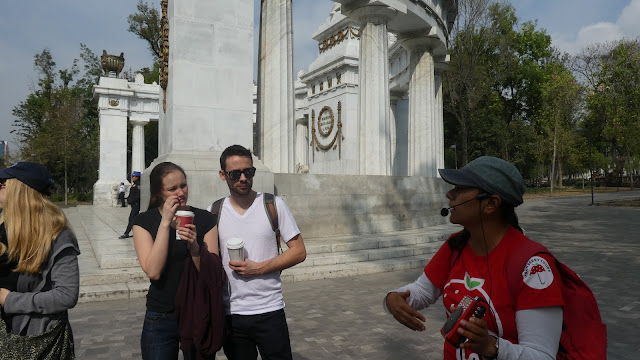
We booked onto the walking tour of the Historic Centre of the city. We had to meet up with our guide who you can see below at 10am next morning. There was about twenty of us at the start and the first thing we had to do was introduce ourselves using the little microphone thingy that you can see Adriana, our guide wearing. About the only thing we all had in common was we spoke English and all wanted to do the tour. Although this latter point may not have been true as our numbers gradually dwindled as the we walked around. We were by far the oldest but also the last ones standing at the end. If you think that this kind of thing would interest you, go to your app store and download Freetour.com for worldwide opportunities.
We are meeting next to the Hemicicio a Juarez a monument to the 26th President of Mexico which is in the middle of the Alameda Park. This was the first European style public park built in the Americas, being created in1529, early in the Spanish imperial period.


The small lanes were devoted to selling particular items, for instance here we are amongst the book stalls which led on to the music stalls. There were, of course tourist stalls everywhere. They were not selling tourists, you understand....


Across the road from the restaurant we were shown the remains of the monastery and church of San Francisco. Built on the site of Montezuma's private zoo, the monastery covered over 30,000 sq m. It was always subject to sinking because of the watery sub-soil. This is actually a doorway into a side chapel, the nave having disappeared. The Franciscan monks were seen as honest brokers, trying to forge bonds between the new religion and the old Aztec beliefs. Shades of Mark Twain, a funeral mass was held here after rumours of the death of Cortes in Central America.

The gilded cage. This rather splendid merchant's house built in the C18 has a sad story to tell. His wife had everything she could wish for within this house and lived in the lap of luxury. The balconies were where she could look out onto Madero Avenue but she could go no further, entrapped as she was within her gilded cage.

Madero Avenue connects the Alameda Park area with the Plaza de la Constitucion running through the middle of the first grid system that the Spanish laid out. It is pedestrianised and one of the important shopping streets as well as boasting a number of historic buildings. The Plaza de La Constitucion, known to all as Zocalo and is the third largest public square in the world. Before you ask Tiananmen Square is largest followed by Red Square. The entire East side is filled by the Palacio National which contains the Federal Treasury, the National Archives and Presidential Offices. The building materials are from Montezuma's Palace which was on this site prior to the Spanish rearrangements. .

La Zocalo was the ceremonial area right back in Aztec times and dead centre in pride of place stands the pole with the National Flag proudly flying. You can just see it to the right side of this picture which also gives an impression of the size of the square. The facade in front is the Palacio National.
 Turning ninety degrees to the left and you see the Metropolitan Cathedral which is built on top of the Aztec temple complex. For a Christian Church the orientation is unusual. You would expect this to be the west front but it is the south leaving the altar facing north, the devil's side.

Just down to the right of this picture is the Templo Major, in English the Greater Temple. As well as excavations of the Aztec Temple area there are some models to give the archeological context of the ruins. Below is the original Aztec city in 1325 where you can see the causeways built for defence and to control access. The Templo is right in the centre.

This is a simulation of the Templo as it would have looked when the Spanish arrived. It is reckoned that it was built on seven times by the Aztecs, one pyramid providing the base for the next.

The excavations as they are today although the picture does the site no justice. Excavations started in earnest in 1979 when a local electricity company discovered some remains while laying a cable. By 1985 the entire area was declared by UNESCO to be a World Heritage Site. This is the place where the human sacrifices took place. According the their beliefs in order for the sun to rise the next day then pumping human hearts had to be offered up (red blood represents red dawn). As a heart will only beat for a few seconds outside the body a line of people was assembled in order to provide a good continuous flow. It never creases to amaze me the things people will do in the name of religion.


After a walkabout and a bite of lunch we tried to recoup some sleep and plan for tomorrow.
You may have heard of Strawberry Tours, they are a walking tour outfit that operates throughout the world. A proportion of the money raised goes to local charities. The tours are free, you can give what you think it was worth. It's a win, win really as the guides are enthusiastic locals whose income is performance related and the punters can't get ripped off.
We booked onto the walking tour of the Historic Centre of the city. We had to meet up with our guide who you can see below at 10am next morning. There was about twenty of us at the start and the first thing we had to do was introduce ourselves using the little microphone thingy that you can see Adriana, our guide wearing. About the only thing we all had in common was we spoke English and all wanted to do the tour. Although this latter point may not have been true as our numbers gradually dwindled as the we walked around. We were by far the oldest but also the last ones standing at the end. If you think that this kind of thing would interest you, go to your app store and download Freetour.com for worldwide opportunities.
We are meeting next to the Hemicicio a Juarez a monument to the 26th President of Mexico which is in the middle of the Alameda Park. This was the first European style public park built in the Americas, being created in1529, early in the Spanish imperial period.

We walked through the park heading towards the building you can see below which is the Palacio de Bellas Artes. The building has an interesting history and a surprise inside. The building which replaced the National Theatre was begun in 1904 and the plan was to open it in time for the centennial of the Mexican War of Independence in 1910. The Italian architect designed the exterior you can see today in a mixture of Neo-classical and Art Nouveau. However political problems intervened in the form of the Mexican Revolution and construction stopped entirely in 1913.
Work resumed in 1932 and a Mexican architect redesigned the interior in the prevailing style of Art Deco. The contrast could not be more striking, whereas the exterior is run of the mill, the interior is stunning. It is actually a fusion of Aztec symbolism and design interpreted through the medium of Art Deco.

Just one shot of the interior (for now) and this does the interior no favours but you can see the box office where we bought our tickets for the show that is advertised on the poster in the centre of the picture.

This is the view across from the entrance to the Palacio of some more commercial Art Deco buildings, see the Sears building on the right. You can see Adriana again in the centre of the picture, well if you look above her head you can see a wedge of paler material which is in filling between the Sears block and the left hand side one. Remember Mexico City is built on a lake so entire buildings oft go on the lean. It is heading towards the base of the famous Torre Latinamricana which was completed in 1956 and measures 182ms tall. It has survived several major earthquakes, particularly the 8.1 magnitude in 1985.

Here it is, if you include the non architectural tip, it is over 200ms high and the major landmark in the Centro.

Next we walked on to the well named Palacio Postal. Built as the central Post Office with magnificent opulence and decoration it manages to keep its utilitarian functionalism. You can trace the worldwide history of postal communications on its walls. Sadly now closed save for a small stall selling stamps it remains a great tourist attraction.

The small lanes were devoted to selling particular items, for instance here we are amongst the book stalls which led on to the music stalls. There were, of course tourist stalls everywhere. They were not selling tourists, you understand....

Here's a bronze beastie with a bronzed lady sitting on it. A decent piece of street art .

Outside the House of Tiles, in Spanish Casa de los Azulejos. Ignore the posey bloke bombing the picture, we are looking at the blue and white tiled house in the background. All three exposed walls are covered with expensively imported Spanish tiles. Built in the C18, the main objective was to opulently display the family's wealth.

This is inside. The building was bought by the Sanborn brothers who run a chain of restaurants throughout Mexico. This is their flagship restaurant which retains lots of period details. We are looking down from the internal balcony and you can see the waitresses in their distinctive colourful uniforms. Just out of sight a pianist adds to the atmosphere. There are several more rooms up here served from the same kitchen. We will eat up here on the evening of the ballet performance.

Across the road from the restaurant we were shown the remains of the monastery and church of San Francisco. Built on the site of Montezuma's private zoo, the monastery covered over 30,000 sq m. It was always subject to sinking because of the watery sub-soil. This is actually a doorway into a side chapel, the nave having disappeared. The Franciscan monks were seen as honest brokers, trying to forge bonds between the new religion and the old Aztec beliefs. Shades of Mark Twain, a funeral mass was held here after rumours of the death of Cortes in Central America.

The gilded cage. This rather splendid merchant's house built in the C18 has a sad story to tell. His wife had everything she could wish for within this house and lived in the lap of luxury. The balconies were where she could look out onto Madero Avenue but she could go no further, entrapped as she was within her gilded cage.

Madero Avenue connects the Alameda Park area with the Plaza de la Constitucion running through the middle of the first grid system that the Spanish laid out. It is pedestrianised and one of the important shopping streets as well as boasting a number of historic buildings. The Plaza de La Constitucion, known to all as Zocalo and is the third largest public square in the world. Before you ask Tiananmen Square is largest followed by Red Square. The entire East side is filled by the Palacio National which contains the Federal Treasury, the National Archives and Presidential Offices. The building materials are from Montezuma's Palace which was on this site prior to the Spanish rearrangements. .

La Zocalo was the ceremonial area right back in Aztec times and dead centre in pride of place stands the pole with the National Flag proudly flying. You can just see it to the right side of this picture which also gives an impression of the size of the square. The facade in front is the Palacio National.


Just down to the right of this picture is the Templo Major, in English the Greater Temple. As well as excavations of the Aztec Temple area there are some models to give the archeological context of the ruins. Below is the original Aztec city in 1325 where you can see the causeways built for defence and to control access. The Templo is right in the centre.

This is a simulation of the Templo as it would have looked when the Spanish arrived. It is reckoned that it was built on seven times by the Aztecs, one pyramid providing the base for the next.

The excavations as they are today although the picture does the site no justice. Excavations started in earnest in 1979 when a local electricity company discovered some remains while laying a cable. By 1985 the entire area was declared by UNESCO to be a World Heritage Site. This is the place where the human sacrifices took place. According the their beliefs in order for the sun to rise the next day then pumping human hearts had to be offered up (red blood represents red dawn). As a heart will only beat for a few seconds outside the body a line of people was assembled in order to provide a good continuous flow. It never creases to amaze me the things people will do in the name of religion.


