Friday, 24 February 2023

Thailand Trail Koh Samui. Sunshine with a sting in the tail


Ko (Koh) Samui is a popular holiday island in the south west of the Gulf of Thailand. It is Thailand's second largest island after Phuket. In 2018 it hosted 2.7 million visitors. People come from all over the world, but when we were there apart from Europeans we mainly encountered North Americans and Australians. The local population is about 70,000. We booked a beachside bungalow at Escape Beach Resort which was a bit outside Mae Nam. Our journey there was somewhat convoluted. 

Firstly we had a 40 minute taxi ride to Don Mueang airport followed by 1.5 hour flight to Surat Thani. Next was a coach trip of about 90 minutes to the ferry terminal and after another hours wait we finally boarded the boat. Note who's doing the heavy lifting!


Pulling away from the mainland and you can see the impressive limestone crags that are a draw for climbers from all over the world. The most famous climbing is to be had at the Railay district near to Krabi. 


A zoom in to our landing port on Ko Samui. The crossing took a couple of hours. My online booking included the airport to ferry transfer, the crossing itself and the onward transfer to the resort. I was pretty impressed by their efficiency considering the booking was made 3 months previously from the other side of the world. 


This is the the final link in the chain. As you can see it is a rather smart customised minibus into which half a dozen of us travelled to our homes for the next week. You will see our transport is right hand drive for the Thais,  like the Japanese drive on the left side. This is a hangover of British influence in the C19.


Others weren't so lucky and got what was somewhat reminiscent of an upmarket jeepney and nearly equally crowded. 


Welcome to the Escape Beach Resort on our first evening. Every resort likes to be able to boast a sunset beach and our private beach could certainly do this. I love the photograph. It looks like the guy on the beach has superpowers to explode mountains. It's all in the timing really. The beach had a small tidal range of about 3 metres but combine this with steeply inclined  sand so the water level never seemed to change much. Just behind the people you can see the end wall of our swimming pool. The wall is to stop seawater splashing in with a strong wind and particularly high tide. The side opposite us is "infinity" and seems to merge into the sea. 


Here is that infinity effect. The trees surrounding the pool are Indian Almonds. Whereas they provide excellent shade, they also have large nuts which randomly fall from the trees and crash to the ground, or your head if you are unlucky. As they are about half the size of a coconut, they could do some damage. 

Talking of coconuts, before tourism they were the mainstay of the island's economy. In celebration of this, the island has opened a coconut museum.  I have discussed single subject museums before. Loyal readers may recall the Reykjavik Penis museum or perhaps the Keswick Pencil museum and don't forget the Tokyo Pot Noodle museum. So I propose the elevate the Ko Samui Coconut museum to join my list of the world's most interesting (?) single subject museums. 


Every good tropical beach bungalow needs its Harry. Meet ours. 


Now for a little look at our accommodation. As well as Harry, we have a seating area with settee, table and outdoor lighting. 


A wee peek into the main room.  A large bed with seating area and table straight across. To the right is the, kitchen or rather the fridge and kettle. Beyond this is the toilet and shower room. To the left is a long desk with telly, which we never turned on. 


Our accommodation was very self-contained. It had a restaurant and a small shop. With the beach, pool and sunbeds, there was really no reason to leave the resort, except who wants to eat in the same restaurant for a week and the shop was small, poorly stocked and expensive. Moreover we wanted to see something of the island. Taxis seemed to operate a cartel and were very expensive so we decided to do what a lot of tourists do and hire a small motorbike. These come with lots of health warnings in the guide books. Although very cheap, they are not insured, most people don't bother with the crash helmets and the attrition rate through accidents is very high. The traffic is pretty horrendous and doesn't seem to abide by any of the rules of the road. Add to all that all these bikes buzzing around the place and you have the perfect storm for a disaster. It won't happen to us, of course. 


Here we are ready to go.Note helmets, on and secure. 


One of the places that we visited on the bike was the so called Fishermen's Village. Up until a few years ago this was a nice beach with a rather scruffy road down to it and another road running parallel to the shore. Now it's been gentrified, a number of smart bars  and restaurants opened and some upmarket fashion shops added to the usual tourist catchpennies. As you can see it markets itself quite well and is (supposedly) traffic free.


Whilst exploring inland I encountered this area. Bull fighting is still a spectator sport in Spain and we experienced cock fighting in the Philippines. I imagine the shortage of bears has put a stop to bear baiting but there's still plenty of pugnacious dogs for people to amuse themselves with. Buffalo fighting is new to me. Apparently the competition takes place twice a year in this particular stadium, but is advertised mainly by word of mouth. The main reason for the event is, of course, gambling and huge amounts of money can change hands. Gambling is illegal in Thailand (as is buffalo fighting). Serious injury rarely happens because the fight is over when one beast turns its back on the other. The cost to attend is £2.50, but women get in free. Is there some sort of double standard at work here?


One of the attractions of Ko Samui is that rain showers only tend to last an hour or so, even in the rainy season. When they come however, they come with a vengeance. This was the view across the bay. 


Remember that motorbike? Well this is the eponymous sting in the tail. On our last day we decided to go further into the centre of the island. There's a precipitous mountain which rises to 2,500 ft with a feature waterfall to visit. I drive us up the the concrete road through the tropical jungle. There is a deep storm drain either side of the 1 in 3 road which bends sharply to the left............need I go on?

Getting the bike off us was the first problem, then getting the bike out of the drain. The helmets certainly prevented serious head injuries. Our upper torsos had definitely sustained damage as had Helen's knee and right hand. Fortunately a local guy came up the road and offered to help. He adjusted and checked the bike, then tested it. The naughty bike appeared to be OK.  So, somewhat chastened and definitely very tentatively we drove back to the resort. It turned out that I had sustained three fractured ribs and Helen bruised hers along with the knee and hand problems. Bruised or broken, the pain is about the same. 

We endured the return journey to Bangkok and spent a day by the pool girding up our loins for the long flight home. Doing this and trying to handle the luggage proved very challenging and without the generous help of the Railway staff across London might well have been impossible. Lastly a mention of Catherine who met us at Spalding and saw us safely home. 

I always like to finish on a sunset, so here it is. 


Friday, 3 February 2023

Thailand Trail north to Chiang Mai

 To be quite honest, the journey from Phnom Penh to Chiang Mai via Bangkok was rather arduous. A case of over ambitious planning that didn't suit the pace we wanted to move at. When you are exploring a new country, the temptation is always to try and see more than the time really allows with the result that things get both frantic and fraught. We left Cambodia by taking a taxi to Phnom Penh Airport. Our flight was delayed by two hours. The result was we had nearly five hours wait before boarding and our flight didn't land in Bangkok until 22-30 and with the sky train and a taxi to come, it would be around midnight before we reached our hotel room. Not much time the reorganise our luggage and pack a larger case which we planned to check in, giving us an extra 20 kgs of luggage. We would have to set out at 9 am to get to Bangkok's other airport from whence we were to fly to Chiang Mai.

Chiang Mai is in the north west part of Thailand and is home to the Lanna people and their distinctive culture. The old city is moated and walled. It is confined to quite a small area although an urban sprawl has developed since 2002. In the C19 this was the domain of the Teak merchants and it was their profits which paid for the numerous Buddhist Wats which abound in the streets. Wat Phra Singh is the principal one, which certainly sucks the money in. 


and inside,


is what the fuss is all about. The gardens are also beautifully kept as is the attendant religious paraphernalia.


You might recognise this image. The reclining Buddha reaching a state of Nirvana. The last one was in Bangkok and at least 10x the size. 


The Wat was at the top of the walking street which is the main road of the old city. It is now filled with coffee shops, restaurants and plenty of market stalls/boutique shops. Virtually everybody is up for a bit of bargaining but unlike so many countries the vendors are not at all pushy. We both bought garments. Well, with nice linen shirts at less than a fiver, who can resist?


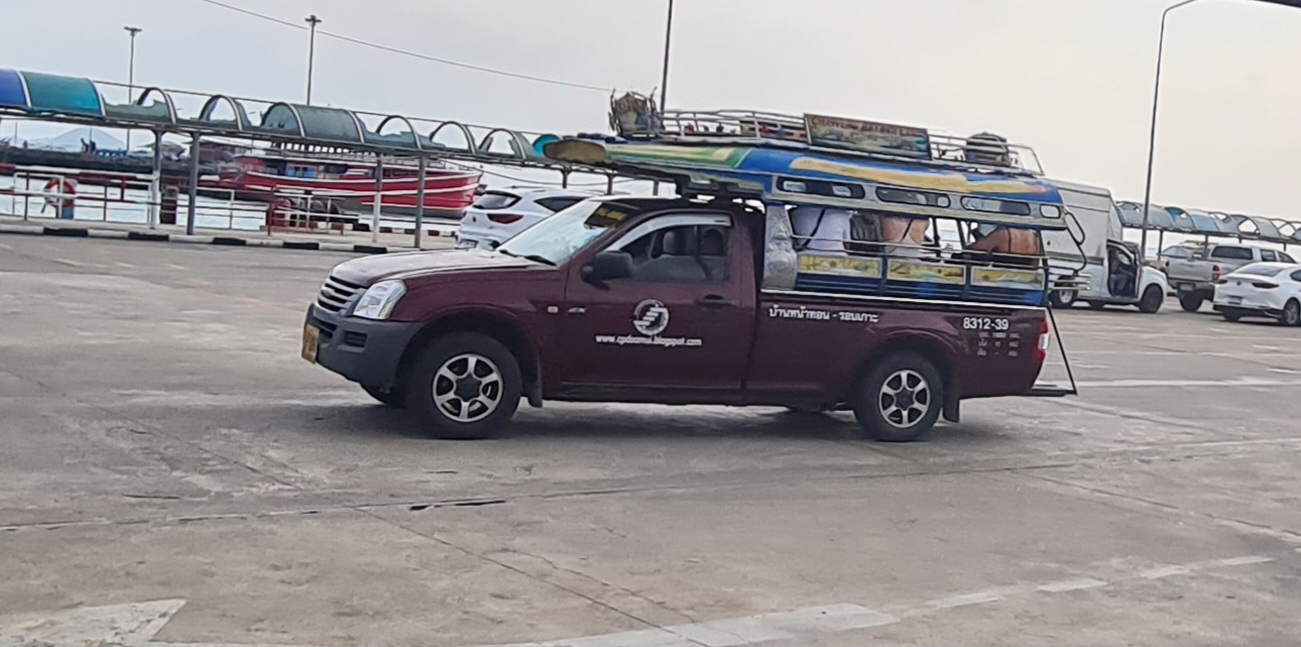
Not so many tuc-tucs here, instead we have the "red car". It's a straight 30 bahts each and you just tell the driver where you want to go to and provided he understands you, he takes you there. 


These guys are owner drivers, a bit like the old Maltese buses. Apart from the colour they are all different configurations within a theme. They are all noisy, smelly and pretty rough inside. 


For tomorrow we booked a river trip and planned to have a Thai massage in the early evening. We were quite a cosmopolitan crew. The local skipper on the rudder, a Thames Estuary man, two Canadians, Helen and me, sitting forward of us was two French men, a Russian woman and a Polish woman. The trip itself was quite weird, We journied for 45 minutes up stream, stopped off for half an hour at a so called farm, then returned to where we had started from. 


The buildings on the riverside ranged from the very modest, built on stilts to keep them out of the flood water,


to the positivity palacial. The one below was hosting a wedding ceremony that day. 


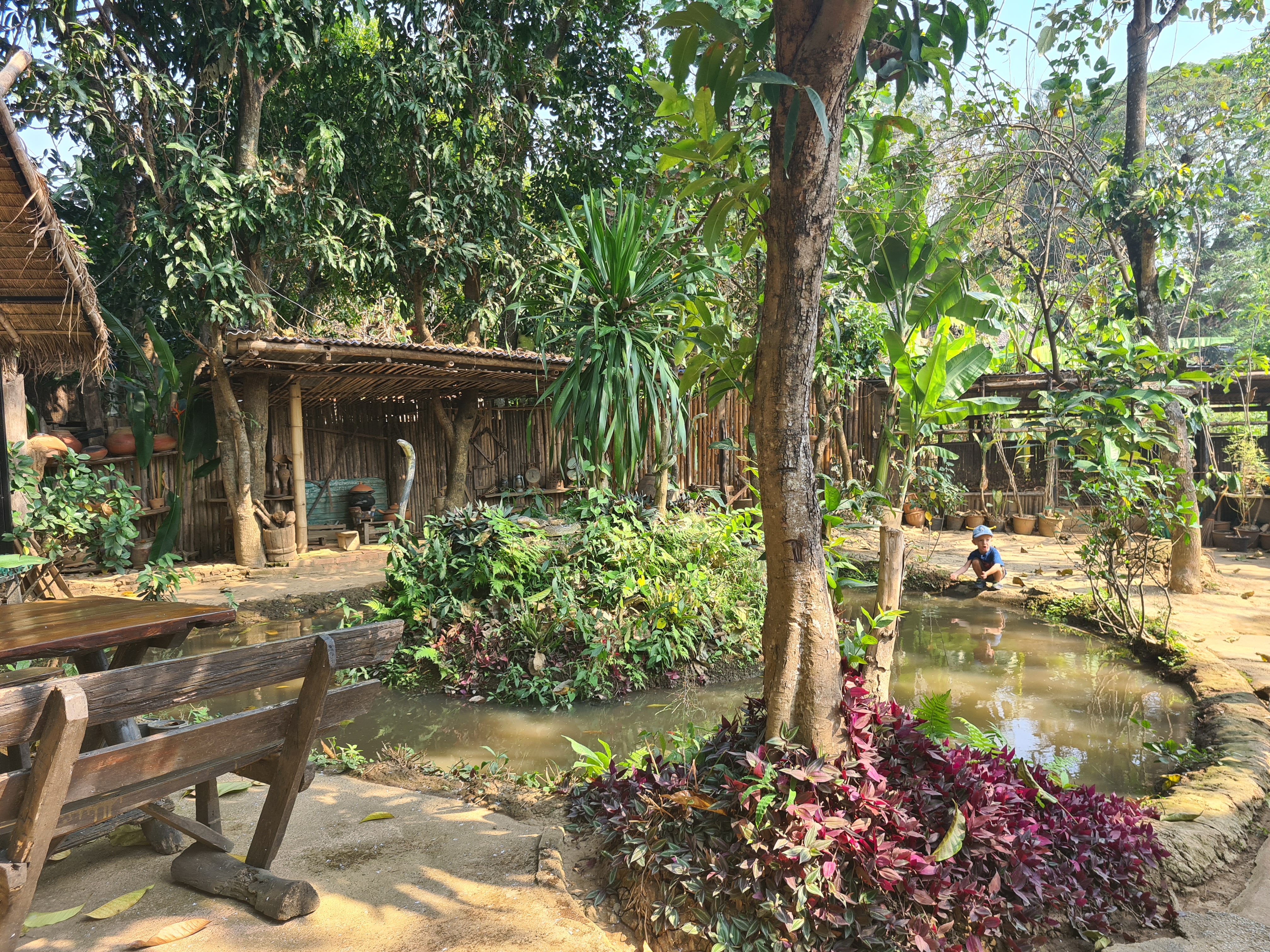
Our destination, the farm. Well it had some bones of animals, old farming implements, dried herbs and spices. They also gave us some herbal drinks and rather nice ice creams. As you can see it is a pretty place and all the stuffed snakes around the pond didn't put the little boy off his play. The river incidently is called the Ping.


The Thai massage was undoubtedly a great experience. We both had the full-body oil massage which lasted for at least an hour for about ten pounds each. A little like the Onsen in Japan it was a cultural as well as a physical experience. One to be remembered and repeated. After our massages we walked out trying to find somewhere nice to eat and have a drink. This place is called the Music Canteen. I put my head around the door to see if they sold food. The pair of us were virtually dragged through the door to come in and join them. It transpired that this was the opening night for the venue which was owned by the young lady who dragged us in. All the people in the venue were her friends and supporters. We were actually her first proper customers! She had run a bar in London before returning home to start this business. The music was loud and the service slow, but good luck to her and we hope she'll still be here in a year's time. 


We had decided to change hotels to be close to the airport that we were both flying into and out of next morning. However someone had still to travel into and out of Bangkok in order for us to refresh our suitcases. I undertook this somewhat daunting task. It involved getting a motorbike taxi to the station then five different trains with four changes and finally a walk to our previous hotel who were taking care of our left luggage. Then the same in reverse. Below, this is the train in the brand new Bang Sue Central Station. This was 11-30 pm and about the last train. The view down the platform to the end of the train. 


The view up the train to the front.


Finally the view inside the train. Nobody would believe that this is public transport in Bangkok albeit nearly midnight. I did get back to our hotel safely. 


Saturday, 28 January 2023

Thailand Trail Monday 23rd January Genocide


I have visited several places where man's inhumanity to man is starkly demonstrated in horrific and very moving circumstances. The Holocaust extermination camp of Auschwitz-Birkenau, The Human Rights Museum in Santiago,  Chile and the Hiroshima Memorial Museum are examples. Tuol Sleng or S21 was a torture and interrogation centre in Phnom Penh during the time the Khmer Rouge were ruling Cambodia from 1975 until 1979. This was one of 189 such centres presently known about. 

Ironically these premises were formerly a High School which adds to the poignancy of its later usage. Firstly a word about the Khmer Rouge. They operated from 1951 until 1999 as the Communist Party of Kampuchea. Most of this time they were an insurgency but the Genocide took place when they were in power. Between 1,5 and 2 million people were slaughtered, about 25% of the population. They were extreme left wing, trying to create a purely agrarian society. Untrained in agriculture people forced out of the city couldn't survive. Famine was widespread. There was no use for intellectuals (anyone who wore glasses), they were all murdered as were all racial minorities. 

Let's move on into the Museum. We had an audio guide so we learnt the whole story in every grizzly detail. 


Block A, the main torture block. The leaders of the regime were paranoid about treachery consequently anyone could be tortured until they "confessed" then executed. S21 was reserved for the hierarchy of the regime. With the efficiency of Nazi Germany everything was documented including mug shots of the detainees. Much of documentary evidence is retained on the premises. Of all the people arrested and imprisoned here over 3 years only 12 survived (more on this later). In front of us you can see the graves of the last 14 people to die before the Vietnamese liberated the city. The total detained here was approaching 20,000.


The perimeter fence. See how close it is to the centre of the city, mind you the city was largely depopulated in1975.


The first of the torture rooms. Torture took many forms, application of electricity, water immersion including water boarding, beating with various instruments, insertion of dangerous insects in various orifices. I think that's enough. Prisoners were manacled and shackled to the bed. The ammunition box was the toilet facility. Spillages resulted in having to lick the floor clean. 


A summary of the rules that were impossible to follow. 


A second torture room. All block A consisted of these. 


This was called the gallows. It wasn't where people were hanged, that would be too quick, rather people were hung by the wrists with their arms behind their backs. When they passed out, they were stuffed head first into the full water jars below. When this was a school it was a play area with climbing ropes attached to the beam.


Time for a break and a little peace and contemplation in the gardens. 


Block B mainly contains the photographic records. You can see the inmates, the cadres who were the warders and torturers, and the leaders of the regime. The upper of the two pictures is of top leader Pol Pot. Incredibly Pol Pot died in his sleep in 1998 whist serving a life sentence imposed on him by his own Khmer Rouge. It wasn't until 2014 that 2 other leaders were tried by the UN for crimes against humanity. 


Block C consists mainly small cells roughly built within what was originally a classroom. They were built so poorly that that  jerry-built iron frameworks were needed to hold them up. 


There were iron staples in the floor to which prisoners were shackled. 


Difficult shot, this one. Victims of the regime. All these sculls have been forensically examined and all the deaths where the result of blows to the head by a blunt weapon. The victims then fell into a trench where their throats were cut, like you would a pig. This created mass graves and saved on the cost of ammunition. 


Another tranquil garden with memorials. Some more thoughts on the insane and paranoid world of the Khmer Rouge. They were autocratic,  totalitarian and repressive. Its insistence on absolute self-sufficiency, including the use of medicines led to the death of thousands from treatable diseases like malaria.  For three years they banned money but salt, rice and gold were still used as currency. 


I mentioned that there are believed to be only 12 survivors from amongst the inmates. This is one of them! He was a 14 year old boy when Phnom Penh and consequently the prison fell to the Vietnamese. His name is Nomg Chan Phal. You can see him with a copy of his book which he is about to present to Helen. 


Friday, 27 January 2023

Thailand Trail aka Cambodian Caper, South to Phnom Penh

 If you remember the bus company that we are using is called Giant Ibis and we are with them again for the 6 hour journey south to Phnom Penh. I have learnt that a group of ibises is called a congregation, so we are about to join the congregation. 


Lunch break at the service area off the main road to Phnom Penh. Driving in this country is rather like India without the cows. You can overtake on any side and drive against the flow of traffic, anything goes, size is what really counts. 


The Mekong River divides Phnom Penh, Cambodia's capital into two. As it is so wide it is expensive to bridge, consequently there aren't many of them. This is the view from the bedroom of our hotel. 


We paid a tuc-tuc driver $15 for the use of his knowledge and vehicle for the afternoon so we could see Phnom Penh's highlights. The first sight we went to was Wat Phnom. Free to locals but $1 for foreigners. It is built on top of a man-made hill and gives you a good idea of how an active Buddhist temple functions.  Here we look back down the hill while we get our breath back. 


These cages contain a lot of tiny finch type birds. People come along and pay to be given a couple of birds into their cupped hands which they can then open and hence release the birds to freedom, I'm sure that this is a very symbolic Buddhist thing to do and deeply meaningful, however it is also a great money spinner. Buddhism is all about the cycle of life and this is certainly a cycle, catch 'em, release 'em, catch 'em, release 'em, catch 'em, release 'em and so on ad infinitum. Just had a thought, perhaps they are homing finches so we could cut out the middleman. Now I know why the caged bird sings.


Looks a bit like a thriving market place, and it is but the purchases are not for consumption by the people. They will all be left at one of the shrines for Buddha's midnight feast. This will ensure good luck for the believers. To me its a bit like leaving that glass of sherry out for Father Christmas. 


Here it is all happening, Buddha presiding over his gifts and devotees. 


We moved on to the National Museum which had a lot of ancient bronze sculptures, but no photography allowed. It also sold some excellent coffee in an attractive garden. Next it was either on to the Royal Palace or the S21 Genocide Museum as both had a last entry in about an hour. There was no contest. The Genocide Museum is so serious and of such importance to the whole world that I am going to devote a discreet blog to it. Meanwhile here are some of the other sites that we took in with our tuc-tuc. 
This is the large park which was decorated to celebrate the very recent Chinese New Year. I hope you can spot that this year is the Year of the rabbit. 


Here we are in Independence Square and it's monument. I never did ask, "Independence from whom?" The French? The Kymer Rouge? The Vietnamese? or The USA? Take your pick I suppose. 


A final photo for the night. We got back to our hotel bedroom after a visit to the night market where photographs were not reccomended for reasons of personal security so this is the same view I posted earlier but this time with the lights reflecting in the Mekong.