Tuesday, 22 October 2019

Japanese Jaunt with a rugby ball. Kanazawa and the Kindness of Strangers

I was a little worried about our accommodation in Kanazawa. I booked through Airbnb and we had a whole house at rather a low price. When we eventually got in the place was great. The only problem was upstairs bedroom with futons and downstairs toilet. The sofa however made a great bed so Helen didn't need to climb the steep stairs. Otherwise the place was brilliant, complete with a massage chair. But let's go back to our arrival in Kanazawa and the station that was at the end of the Shinkensen line.
This is the outside concourse of Kanazawa main station. The gate you can see just below the hanging banners is an intriguing design. Made of wood shaped into a spiral, they are a scaled up version of a famous shrine gate and function not only as support but also as rainwater drains from the huge roof and snow chutes.


Kanazawa calls itself the "Jewel of Japan " and with some justification. It is not yet really on the tourist route but it is quickly getting there. It's a city with great creativity and imagination combined with traditional cultural assets. It is famous for its food scene, particularly seafood. Come and explore. 

This is called the Kenrokuen Gardens. The manager of our accommodation kindly gave us a lift here without any asking. They are reckoned to be in the top three gardens in Japan. Extending to 11.4 hectares it was originally the private gardens of the ruling family that lived in the nearby castle. They were designed in the Edo period C18 and C19, but are now open to the public and like the castle next door are free of charge for the over 65s. This privilege is extended to visitors on production of ID. The blossom in Spring is a star attraction. 


This fine gentleman is the restored Emperor after the Meiji Restoration of 1868.


Other activities take place within the gardens. Here, I have muscled in on what was probably a wedding shoot. 


Next visit is to the vast castle where again we were able to take advantage of our geriatricy. Owned by the Maeda family of noble war-lords, who took the castle in 1583. There were several devastating fires followed by rebuilding. The castle had the nickname of the Palace of one thousand tatami mats indicating its massive size. It was still standing until the Meiji Restoration when seemingly it was razed. The present structure is a contemporary rebuild which includes useful things like concrete foundations and lifts for the disabled, not forgetting the sprinkler system. Traditional building methods are faithfully followed. I am really not sure about this Japanese technique of restoration, but I suppose it keeps history tangible. 


As we crossed this square it started to rain and it wasn't long before a couple offered to give us plastic ponchos. Yet more un-asked for kindness. Helen posted this picture on Facebook which gave rise to much comment and not a little hilarity. I really cannot understand why. 


The rain shower turned into a torrential downpour that lasted for the rest of the day. We had an appointment with a rugby match to fulfill and managed to book into this sports bar which was probably one of only two places screening the game in town. We squeezed in with a selection of Aussies, Kiwis, Brits and Japanese. There was about 15 of us in a room that could comfortably accommodate 10. We witnessed England trimming up a disappointing Australia and then the All Blacks giving Ireland a pasting. 


After all this we were faced a soaking walk back to the house. We ducked into an Italian restaurant for a drink and a break from the rain. When we came to leave the owner presented us with an umbrella to take home. The kindness of strangers. 

Monday, 21 October 2019

Japanese Jaunt with a rugby ball Kyoto up and under Fri 18th Oct

Having completed our visit to the Imperial Palace and gardens we headed for the hills. The rising ground in Kyoto tends to be where the temples and qshrines are located. We were headed for Konchi-in, a famous Buddhist Temple founded around 1400. Firstly a little background on Japanese religion. The two major religions are Shinto (52%) and Buddhism (35%). The two happily coexist and even sometimes share the same building and to a certain extent compliment each other. Shintoism is as old as Japanese culture whereas Buddhism was imported from the mainland in 600 CE. Shinto is an optimistic religion where man is basically good but can be affected by evil spirits or Kami. Most of the praying, cleansing and offerings is to avoid the Kami or bring good luck in various aspects of life. Most Japanese today wouldn't consider themselves religious but would participate in ceremonies honouring those milestones in life, birth, death and marriage.
Back to the Konchi-in. A Buddhist Temple, remember with especially fine gardens.


Eat your heart out Claude Monet, meanwhile the Koi are having a good feed. If you look carefully you might be able to see a turtle amongst the Koi. In case you can't see it, try the next picture.


I love this picture as it demonstrates the close relationship between the various elements within the garden. The tree and the rock compliment each other perfectly. Incidentally the tree is not completely dead, just very old. You can see living branches if you look closely.


We moved on via the excellent subway to the Nijo-jo. This is a castle 
built in 1603 by the Tokugawa Shoguns in order to demonstrate their power, particularly compared with that of the Emperor. The place is huge, the building is just a corner tower and look at the length of the moat and outer walls. The palace inside was constructed with "nightingale floors " that sing and squeak at every move, making it difficult for intruders to move about quietly. No photos inside the palace. 


This is the main entrance gate. The light just beginning to fade. 


On our way back to the subway we encountered a shop selling formal Samurai gear and swords. They weren't cheap, the equivalent to Holland and Holland. The most expensive ones were the antiques, a single small blade was a million yen, well over £7000. We just bought the smallest one we could afford. 
Just outside Kyoto station square is the famous Kyoto tower. The observation deck stands 100 metres above ground. This retro looking building was constructed in 1964 designed to mimic a lighthouse, but I feel gets closer to a space rocket. It was the first tower in the world to adopt a monocoque structure and is designed to withstand typhoons and earthquakes. 


The observation deck is just below the red ring of lights with the telecommunications equipment standing above it.


This is looking back to where the last picture was taken from. Pretty well dead centre just below the red horizontal bar. 
So we trained back to pack up ready for the trip to Kanazawa tomorrow. The train we have booked on is called Thunderbird and in addition to exploring this city we have the prospect of the Wales v France quarter final. Thunderbirds are go!


Saturday, 19 October 2019

Japanese Jaunt with a rugby ball NE to Kyoto Thurs 17th Oct

From CE 800 up until the Meiji Restoration in 1868 Kyoto was the capital of Japan. It then moved East to Tokyo (interestingly an anagram of the old capital). Kyoto famous for its numerous Classical Buddhist Temples, as well as gardens, Imperial Palaces, Shinto shrines and traditional wooden buildings. It is here where you are most likely to see people dressed in the traditional clothing. Appropriately enough we rented a small traditional home to live in whilst we are here. Welcome to Casa Saka.


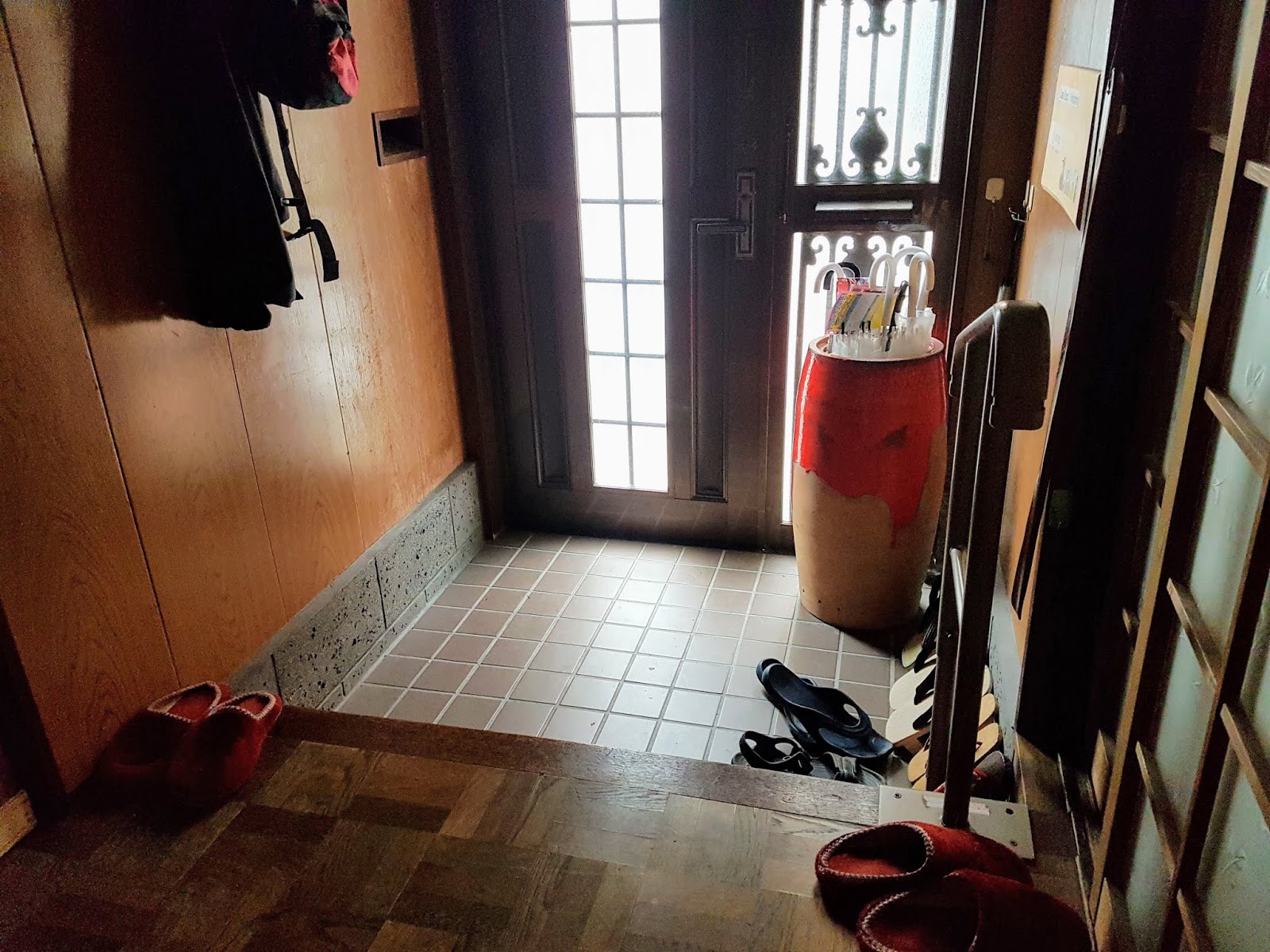
This is upstairs with our futons out ready for bed. Notice the old family trinkets and the reed tatami mats on the floor. You don't walk on these with shoes on, they come off at the front door and slippers are worn around house except for the bathroom and toilet where special slippers are needed. We found the futons tricky to get up from and hard on the floor. They are easily lifted and stored away during daytime giving a bedroom more use than just sleeping in. The Japanese are keen to use space as efficiently as possible.
All doors are sliding and most are wood frames with silk stretched around them. It is also very easy to reconfigure the spaces. This shot of the upstairs gives a good flavour of the place.


Downstairs now and this is the front door and porch area. Outdoor shoes go no further than the tiles, slippers and worn once you go up the step. You can see the slippers lined up ready for use. Notice the copious supply of umbrellas in the red stand.


Hirotomo who was born here, now lets it out on Airbnb. The location is in Otsu a few kilometres outside Kyoto, two short commuter trains to Kyoto Central Station door to door.
First day we decided to explore our immediate surroundings so we went out for a walk. We headed about 200 ms along the canal constructed in the late C19 till we reached the shore of Lake Biwa. This is Japan's largest and deepest lake by a long chalk. Not only that, it is also classified as one of only a dozen of the world's Ancient Lakes. This puts it in the same bracket as Lake Baikal and the Caspian Sea. Such a noble body of water cries out to be cruised on.


What better ship than the sternwheeler Michigan. We had a two hour triangular cruise. In case you are wondering what a sternwheeler is, it is one of these.


Wednesday, 16 October 2019

Japanese Jaunt with a Rugby Ball Kumamoto 13th October

Day return on the train to Kumamoto. We're hoping to be able to buy a couple of tickets for the Wales v Uruguay at the railway station when we arrive. Failing that we shall visit the famous castle then go to the fanzone to watch Wales then stay on to watch the Scotland v Japan match which could be a classic.
When we got to Kumamoto station we had a pleasant surprise and a disappointment. We were presented with rather nice World Cup lapel buttons by a welcoming lady but the information desk told us that all tickets for the match were sold. I really didn't think Wales v Uruguay would be a sellout in a 30,000 seater stadium, but there was an Eisteddfod of Welsh people on the station alone. But, I think the real problem is that the Japanese have really taken the competition to heart with the success of their team.
So Kumamoto Castle it is.


Some historical background, what this board doesn't tell you is that in 2016 there was a massive earthquake here which did an enormous amount of damage. The process of rebuilding and making the structure safe will take an estimated 20 years. The castle has been closed to the public ever since. Today however is the unveiling of the main part to visitors again. You can't fault our timing!


There follows a couple of pictures to illustrate before and after the earthquake. The first picture is a picture of a picture if you see what I mean. This is how it used to look immediately  after the earthquake.


And this is what you see today after 3 years rebuilding.


But there is still a lot to be done and I don't have the time to do any more today.


There was also lots of events in the large park by the entrance. Bands came to perform and dance troupes awaited their turns. There were special local food stalls and a beer tent. I opted for a sort of noodle soup with wild boar meat on top and Helen had Japanese fried chicken.
Earlier we had been given free tickets for a tea ceremony which was due after lunch. Just a privileged group of about thirty of us gathered for this. Actually I found the ceremony as disappointing as the tea. We sat and watched while a kimono togged woman did the tea preparation ("some prepared earlier") also appeared from the tent behind. The prepared tea was handed out and ceremonially drunk. This process was then repeated. We were also given a little cake to eat which contained the ever popular sweet potato. Have a wee look at it. The woman doing the upfront preparing.


The handing out of the tea.


Finally the tea itself.


Maybe I'm missing something of the aesthetics of the ceremony. I'll have to read up on it.
Back on to the bus and down to the fanzone. Although the area was pretty full it was also patently poorly laid out and planned. It was OK for a couple of hundred fans but if it were to fill up it would struggle to be a good experience for anybody.
When we arrived the game on was USA v Tonga. About a third of the crowd were Welsh waiting to be bussed down to the stadium so they would be leaving soon. Even then there was clearly going to be a problem seeing the action and the prospect of standing for nearly four hours was not a happy one.
A steward came round to tell us to go to the buses if we were going to the stadium. I took the chance to tell her what I thought of the fanzone arrangements. Only one big screen which was mounted far too low, merchandise stalls completely sold out, and a ludicrously small amount of seating. It was I told her, the worst fanzone I had ever seen in the last five World Cup competitions. I asked her to pass on my comments to the person in charge.
I expected to hear no more but within ten minutes she returned with the Head Honcho who thanked me for my observations and offered to improve our viewing experience. He proceeded to show us into the VIP area which was the first two rows of benches. There were no other VIPs present!


Below you can see the most important VIP in the VIP area. As you can see this is towards the end of the USA Tonga game. Wales will kick off in about 40 minutes time and we will have one of the best views in Japan.


Although there was never any chance of Wales losing to Uruguay, it was a most frustrating game to watch. Firstly they rested as many starting players as possible. Secondly they couldn't retain enough possession to get any rhythm. This was mainly due to handing errors, forward passes, and silly penalties. They must have had five tries disallowed. In the end it was job done with no injuries to complicate selection for the quarter final. There was a half hour gap before the third and last game, Japan v Scotland. There was some onstage entertainment to fill the time before kick off. 

The fanzone was now filled to capacity and it was announced that anyone leaving the area will not be readmitted. We were virtually entirely surrounded by Japanese fans. Some had even sneaked into our area!

Watching that game was a wonderful experience. We were in the middle of a cauldron of intense enthusiasm, the crowd was very knowledgeable, cheering every turnover and tackle and going completely ecstatic when Japan scored. 
At half time with Japan in the lead, the guy in the picture below took the chance to address the crowd. Note the Mandela touch with the rugby shirt. He was the Governor of the Prefecture and was riding the wave. 

Scotland really should have scored a try in the dying moments with Japan leading 28-21. Such small things, careers turn on. 
The place went ballistic on the final whistle. 


All we now had to do was get back to the railway station on the tram. Sardines in a tin would have been much more comfortable. 

Monday, 14 October 2019

Japanese Jaunt with a Rugby Ball. Kagoshima in the shadow of a volcano 12 October

The typhoon Hagibis is due to hit mainland Japan today. Fortunately we are in the furthest south island and about 1000 kms away in the Tokyo area. We are planning to head north to Kumamoto where Wales are due to play their final group match against Uruguay. If they win this game they will top the group with Australia second. That is tomorrow however, today we can explore Kagoshima then find a bar to watch Ireland play Samoa.


This is the object that rather dominates the city of Kagoshima. It is Sakurajima which is Japan's most active volcano. Until the 1914 eruption it was an island in the Kinko Bay but the consequent larva outpouring left the island permanently attached to mainland. It "burps " about 1000 times a year and you can see a burp is taking place at the moment. There are three summits only one of which is active and smokes all the time. 
In Japan umbrellas have two uses, protection against the rain and the sun. In Kagoshima there is a third use against the volcanic ash which coats the landscape like snow and obscures the sun. It gets in the hair and even the teeth. There is a special weather forecast about the state of Sakurajima and its fallout. There are even snow globes with the mountain and black snow!


We took the ferry across the bay for a closer inspection. 


Whenever you are next to a volcano a few of these come in handy. 


In case of emergency as they say. After crossing back we then took the hop on, hop off bus service which is run by the city authority rather than the big red bus that you see all over the world. At lunchtime we got off at a local park where there appeared to be something afoot. 
It turned out that we had stumbled across the annual Kagoshima curry festival. The first people we spoke to were Bangladeshi exiles running a Biryani stall. It was ever thus. We went for the less ubiquitous Japanese curry which was delicious. 


We were also serenaded by a talented female musician who was performing on the yellow stage left.
On with the bus tour and we alighted at this UNESCO World Heritage Site. This was a bit like Glover and Nagasaki all over again. Another Japanese "Ironbridge" place. The local ruling family invested in British knowhow and ingenuity, building a reverberating furnace, to make cannons originally and a mechanized textile factory. They already earned plenty by exporting the local Satsuma ware pottery. 


This is the entrance to their sprawling house. Note the family coat of arms with the cross shape and the beautiful garden they replied created. It was in this garden we enjoyed some locally made sweet potato flavoured ice cream.  


We took the bus round to complete the circuit, running through the dock area. Here was a link not only to England but locally to Norfolk. By the end of the 19 century Japan was able to build steel warships it just needed the experience and strategy of an Admiral. They found one in Toto, born here, trained in Britain. He soundly defeated the Prussian Navy in 1904/5 and gained the soubriquet Nelson of the East. No picture of him, alas. 
Instead here is a picture of a dragon fruit being held by a lady at a farmer's market which was taking place in the station square. 


I told her that the dragon was the symbol of Wales and they were on their rugby shirts, like the one that I was wearing. 
It was now late afternoon and time to find somewhere to watch the Ireland v Samoa match. I enquired at the tourist information office for help and they suggested we try a bar called Big Ben. Our bus tickets included the trams and so we rode and walked there only to find a subterranean restaurant with no tables available but frustratingly the televisions were showing the rugby. The owner was keen to help us and indicated that we should try across the lane and up the steps to another one roomed bar/restaurant. Against all expectations the owners and the one other customer,  who could speak English, attempted to find the rugby on the telly but without success. We thought we might as well have a drink and clearly that would involved eating the food from the bar. 


Well things began to develop especially between Helen and Hiroto who seemed to find lots of common ground except a common language. The friendly relationship grew as we enjoyed several of their excellent dishes including eel stew apparently an excellent aphrodisiac for men. By now it was half time in the rugby and magically they managed the get the rugby on the telly. 


Hiroto's hobby was painting and all the pictures that you can see in the bar were by her competent hand. I was now enjoying the rugby and chatting with Massa, the original customer and Helen was ensconced with Hiroto and a couple of other regular customers. We eventually had an emotional farewell with Hiroto saying it was the best day of her life. 


Friday, 11 October 2019

Japanese Jaunt with a Rugby Ball. An unsung hero and a song that's never heard. 10 Oct

We are only a two hour train ride away from Nagasaki so we really must go and visit this fascinating but tragic city. In many respects Nagasaki is Japan's Ironbridge and this has nothing to do with the events of August 1945.
Ironbridge is known as the cradle of the Industrial Revolution which came to Japan, after about 200 years of complete isolation in the middle of the 19th century. Scotsman Thomas Blake Glover aged 21 arrived at the opening of Nagasaki port in 1859. Initially he was a tea merchant popped over from Shanghai. He soon expanded his activities into arms sales, warship building, coal mining, dock construction, railway building and brewing. He was a voracious and unprincipled capitalist. He supplied arms to several of the in-fighting clans. He helped set up and finance the Nagasaki Ironworks  (which later became the Mitsubishi steelworks and ironically the excuse the Americans used to drop the atomic bomb on Nagasaki).
He set up a joint venture whereby 5 young men were sent to London to study Western Industrial methods. The Choshu Five as they became known later went on to be Prime Minister, first ever Foreign Minister, Industry Minister, Railways Minister and finally Master of the Mint (which Glover had, of course founded). Glover was awarded the Order of the Rising Sun by the Emperor, the first foreigner to receive the award. Quite a Cecil Rhodes and just as controversial but without doubt a huge influence on the modernization of Japan. He is my unsung hero.
Nagasaki was also the setting for Puccini's opera Madame Butterfly (guess who owned the house where the action takes place). Enough text, it's time for a picture, so why not another train.


Helen and I arriving at Nagasaki station. Note the name of the train company next to ours. Despite all the history and culture in this place it is very difficuult not to have what happened at two minutes past eleven on the 9th August 1945 in the very forefront of your mind.


In case anybody is unsure what I am talking about, this, (or something that looked very like it) was dropped from an American plane. 500 metres above this statue the second atomic bomb exploded. The Americans nick-named this device "Fat Man" in contrast to "Little Boy" which was the bomb they had exploded over Hiroshima 48 hours earlier. The two bombs were entirely different even down to the type of nuclear reactions. It was clearly important to learn as much as possible from this cynical killing experiment. You will hear the argument that they shortened the war and therefore saved hundreds of thousands of lives. Inconveniently for this rationale, the Japanese Emperor had signed the peace treaty before either of the bombs were detonated. 


These are not workers in hard hats but Japanese schoolchildren filling in their worksheets which are following the National Curriculum. Here we are in the Atomic Bomb Museum which pulls no punches. Some of the photographs are both graphic and horrific. One third of the city of 240,000 people died that day or soon after. The killing power of modern nuclear weapons is many thousand times greater than these early "experiments ". As you leave the museum the last section is devoted to the countries that possess nuclear weapons today and what their armouries consist of. In nearly 80 years, it seems that we have learnt nothing. We are giving people like Donald Trump the button to press that can annihilate our planet.
The panoramic photograph below, as you can see from the inscription was taken on the 20th October 1945. Look how identical the skylines are but how the fore grounds have changed.


On some higher ground upstream of the hypo centre is the Peace Park which we walked round. It was interesting to compare various the types of sculpture from all around the world that had been commissioned mainly by cities rather than countries. A disappointing number worked on the old cliche of children held aloft and of course there were flocks of doves. Three now defunct countries stood shoulder to shoulder, Czechoslovia, DDR and USSR, none of which had much artistic merit. Look at the central statue by a Japanese sculptor and below it, the explanation.


There was a choir of schoolchildren singing a song of peace in front of the statue whilst we were there. They sounded beautiful in their innocence. That is my song in the blog title that's never heard.
I don't feel that I can add any more to this blog, other than to leave you with some of the pictures of statues that we liked.


The cloak of peace from many cities in New Zealand


The hand of friendship from Turkey.  To close something a little more horrific from outside the Museum.