Monday, 24 February 2020

Briefly in Beijing Temple of Heaven 7th Nov.


This is our last full day in China and we are visiting the Temple of Heaven so I would like to start by giving you a little context. In ancient China the Emperor of China was regarded as the Son of Heaven, who administered earthly matters on behalf of, and representing heavenly authority. To be seen to be showing respect to the source of his authority, in the form of sacrifices to heaven, was extremely important. The temple was built for these ceremonies, mostly comprising of prayers for good harvests. How he explained away poor harvests despite his heavenly intervention is not recorded.
The whole site is huge and a popular local place for recreation. All along this covered corridor there were groups of people playing cards whilst enjoying the sunshine. 


Above the card schools you can see the magnificent painted decoration on the ceiling.


Now a brief history of the parks and its structures. First constructed between 1406-1420 and used by the Ming and Qing Dynasties. Extended in the C16 and renovated in C18. The early C20 saw deterioration and occupation after the 2nd Opium war and the Boxer rebellion. It was turned into a park and opened up to the public in 1918 and in 1998 it was inscribed as a  UNESCO World Heritage Site.
Remember the sacred number nine, that and nonuples thereof figure, as it were, throughout all the structures. Count anything, steps, balustrades, beams, columns, etc. and 9, 18, 27 etc. crop up every time.
Below is one of the three most important buildings in the complex, namely the Hall of Prayer for Good Harvests. This is built on a mound which you can ascend via the steps and balustrade.


Walk up the 27 steps and you're now level with the building.


The view looking west from the Hall. The red hats are coming.


The red hats are here. A more symmetrical view of the Hall of Prayer for Good Harvests.


The following three shots try to get an impression of the inside of the Hall. These were not easy to take because it was a squash to even get close to the open doors, then there were barriers that kept the crowds at least a couple of metres away from the building. This picture tries to show the internal decoration.


Like our house, the place could do with a bit of a clear out.


Imperial vermilion makes its inevitable appearance and at least my shadow gets into the sacred space.


Some of the more spectacular and extravagant examples of the modern Beijing skyline are not far away from us. This photograph also gives some idea of the air pollution in central Beijing.


The three important buildings in the Park lie on an north-south orientation. The pathway down the centre was for Imperial use only. Here we are looking down that path towards the Imperial Vault of Heaven. Blue is the colour that represents heaven, hence the blue roofs, ceilings and upper wall decoration.  Notice the wall around the building you can see through the keyhole. I'll return to this later.


Here's the Imperial Vault of Heaven. It is similar to the Hall of Prayer but smaller. Round is the shape that represents Heaven. Back to that wall again, which is in the background and ochre coloured. Again round but it has similar properties to the whispering gallery in St. Paul's cathedral and  is unsurprisingly called the Echo Wall. The vault, constructed without the use of nails also has no cross beams to support the weight of the dome.


South of the Vault is the third important structure called the Circular Mound Altar. It is an empty circular platform on three levels of marble stones each decorated with lavishly carved dragons. The numbers of the various parts, steps, balustrades are again nine or nonuples. The centre of the altar has a round stone called the Heart of Heaven. The Emperor's prayers for favorable weather would be reflected by the guard rail creating significant resonance which was supposed to help the prayer communicate with heaven. The Altar was built in 1530


The time was by now 5.30 pm and the museum part of the park was closing and we were obliged to leave by the south gate. It transpired that this was some considerable walk west then north around the perimeter of the complex in order to get back to our metro station for the hotel. Not what I would have planned at the end of an all walking day that came hard on the heels of the Great Wall marathon. The last picture shows the local district primary school and a tempting street food vendor.


So it was home to pack, sleep and perchance to fly.


Sunday, 15 December 2019

Briefly in Beijing The Great Wall Wed 6th Nov

Today we have devoted the day to the conquest of the Great Wall of China. As the existing wall is about 8000 kms we decided to restrict our efforts to the Mutianyu section. This is located about 70 kms northeast of Beijing and is considered the best preserved part. Started in the C6 I reckon this part has been continuously preserved ever since. In fact there were workmen on it as we walked the wall. Built to defend the Capital and Imperial Palace tombs from any invaders from the north.
The Mutianyu section of the Great Wall has the largest construction scale and best quality amongst all the surviving sections of the Great Wall. It became a UNESCO World Heritage Site in 1987. In 1992 Mutianyu was rated best tourist spot in Beijing. Below is the map of the part that we are tackling today.


We had to get up at 5.30am for a 6.30 breakfast and despite, or maybe because the cook had also to get up an hour early, the breakfast was still cold. We then walked down to the end of our hutong to rendezvous with the minibus which took us all of 400 ms to where our bus turned up. The journey was about an hour and a half with the last half hour taken up with a lecture on (I think), the Great Wall of China, by Toni our Chinese guide. He explained that the walk was lengthy and arduous. Only the strongest should attempt to get up to the 21st watchtower. Well that sounded like a challenge. 
The picture below is not mine, but a download. You can see the weather is a lot clearer. This was taken from the 13th watchtower and shows rather nicely the whole length of our walk. The 21st watchtower is on the horizon, expand the picture to follow the wall to the top. 

Toni explained that there are two ways up to the wall, by cablecar or walking and three ways down. Two as up plus a dry slope tobbogan. As you can see we ascended via the cablecar. Notice how forested the area is with lovely autumnal colours in early November. 


The 13th watchtower from the cablecar. It is still pretty misty but not much after 9am. We were supposed to get back here and down to the restaurant by 12.30 when lunch would be served. 


At the real start up on the wall and Helen posing next to the accolades. Despite what Toni had said, little did she realise the demands that she would face. 


Another misty picture from early on but it looks worse than what we experienced. The vast majority of our fellow walkers were Chinese tourists. Our own party consisted of about twenty from Europe and America. Several only made it to the first watchtower. 


The camera does tend to level out what are quite steep gradients and you have to look carefully to appreciate the number of flights of steps. 


Helen kept saying to me from watchtower number 17, "Shall we just do one more watchtower?" To which the answer was "OK". So we trudged on. Around watchtower number 19 she had teamed up with a young group of three girls and one boy from Switzerland. The girls more or less decided that Helen was going to make the top.  From 20 to 21 the gradient was 50 degrees with a 70 degree staircase ramp as a sting in the tail. Here we are looking up to the final assault. As you can see there are little stopping, resting walls on alternate sides of the steps. 


Those girls really worked wonders for Helen on that last pitch and she really busted a gut in her determination to reach that summit. I was running on reserve tank as you can see in my face and our Swiss friends went on up to welcome us to the top. 


As we made it, there was cheering and applause from everyone on the top. Bouyed by the enthusiasm of all the youngsters at the top Helen felt a very real sense of achievement. This is the part that I described as the sting in the tail and we have climbed down again. Look at the couple above us to get some idea of the angle. 
  

This is the end of the part that the public can walk on, but of course someone always has to go further. There was a guy who had a makeshift stall about 20ms higher and had set up a fake border crossing where for a small fee he would snap you on your phone. There was also a fella who had carried a crate of beers up which you could buy at highly inflated prices. What a way to make a living. 


A kind Chinese couple took this nice photo of us with the wall stretched away in the background. What appear to be flag poles on the watchtowers are in fact lightning conductors. It was about here that we met up again with some others off our coach. It transpired that besides us only three others actually made it to watchtower 21. Well, youth of today!


It's a fallacy that the Great Wall of China is the only man made object that can be seen from space. It depends what you mean by space I suppose, maybe outside the earth's atmosphere. Anyway you can see the light from cities but you can't see the wall. What we did see amongst the many Chinese was a stream of fell runners from Cumbria. As they were wearing vests and numbers I assume it was a competition but I didn't stop them to ask. I bet they didn't use the cablecar. Not surprisingly we were a little late back for lunch but the lunch was good. We all sat around a large circular table with a lazy Susan in the middle on which was a great variety of meals. After lunch it was bus back to Beijing and we arrived at the hotel again at about 3.30.


Thursday, 28 November 2019

Briefly in Beijing Tuesday 5th November

As soon as I learnt that the 144 hour transit visa for China existed at nil cost I determined to make Beijing a stopover on our return journey from Japan. It's also why I decided to fly Air China.
I didn't expect China to be easy but didn't quite anticipate the problems that we encountered. The first arose in connection with our accommodation. Two weeks into the Japan visit I received an email from the accommodation that I had booked in Beijing to say that my credit card had been declined and they were cancelling the booking. After contacting the bank they assured me that there was no problem with the card and that the terminal in China was where the difficulty lay. I  quickly booked another self catering apartment and organised a taxi to avoid the kind of problem we experienced when we first arrived in Japan.
Two days before we were due to leave for Beijing I received an email from the apartment owner telling me that the immigration authorities would not accept an apartment as being a suitable address for a transit visa. I would have to get a "regular" hotel. So all arrangements in tatters and less than 48 hours before we arrived in Beijing.
I got back onto Booking.com and got into a courtyard hotel in a hutong. That is a traditional alley that runs off a main street. We're quite central in Beijing and these kind of properties are very trendy for cafes, bars and boutique shops. Our hutong however remains very traditional. They can also arrangeAirport collection at half of the cost of the previously arranged taxi. You can see part of our room which was on the first floor with a view over the courtyard and beyond central Beijing.


Beijing airport is one of the biggest I have ever encountered. Along with a small group of others we had to go to a small separate desk to fill in our paperwork for the transit visas. By the time this was all completed we were well behind the rest of our plane load. To get from the immigration hall to baggage reclaim and customs you had to go on a five minute train ride. It had taken us over an hour and a half between landing and reaching the arrivals hall and I had serious doubts if our driver would still be there. Thankfully there was a little grinning Chinaman holding up a bit of cardboard with Nigel Duce written on it. He had absolutely no English but he knew where he was going and I knew that we would be in bed before 2am. Despite the late night we didn't get a great night's sleep because of a vibration caused by the air con, so next morning we asked for a move and got upgraded to a larger room on the first floor. The window overlooks the courtyard and central Beijing is visible not far away. 

It also immediately became apparent that although the hotel had wifi and we could log on to it, it was absolutely no use to us. It did not support any Western platforms. No Google in any of its guises. No Facebook. No Western news media, including BBC. Big Brother was stopping the other Big Brother looking after our interests.

We went for breakfast which was consistently poor. There was a choice of one from four options, no mix or match. 1, Chinese take on a fried breakfast, two sausages, two bacon slices, two hash browns, two tomatoes, two eggs fried and rolled, two pieces toast and one coffee. Sounds good but not when semi cooked and cold. Option 2 was the same as 1 but half the quantity, 3 was the continental option, pale toast and jam, finally 4 was the Chinese option of rice and rice. 
Napoleon said that an army marches on it's stomach so with that in mind we marched out to find the subway to the Forbidden City. 

Here's Helen about to enter through the Meridian gate at the south end of the complex opposite Tiananmen square. 


The Forbidden City is a palace complex which housed the Ming Dynasty (1368-1644) followed by the Qing Dynasty (1644-1912). It was built 1406-1420 (mind you, it's had a lick o'paint or two since then). Consisting of 980 buildings over 72 hectares. It is a vast site. UNESCO declared it a World Heritage Site in 1987 and lists it as the largest collection of preserved ancient wooden structures in the world. It gets its name because no one (not just "foreigners") was allowed to leave or enter without the permission of the Emperor. You will notice that there are quite a few visitors around in the photos, this is because it gets 16.7 million of them every year. That averages out at 46,000 a day. 
The architectural style is Ming and quite frankly, although very impressive, a bit samey.
One or two things from the picture below which is the Gate of Supreme Harmony. There is the Imperial Way which is the line or path which goes south to north, bisecting the city on a longitudinal axis. This is, of course for Emperors only. You can judge the status of a building by the number of little animal figures carved on the ends of the eaves, I think the largest number is 11, but you can have fun counting them in the different pictures!


Vermilion is the Imperial colour so it's everywhere, here in the wooden pillars and doors. Note the brass studs on the doors, 9 rows of 9 studs. That number is very important, but more of that later. Notice also the wonderful ornate wooden carving of the ceilings. 


Passing through the doors above we entered another courtyard area. This is the area which leads to Hall of Supreme Harmony. It is in this courtyard that that these two guardsmen facing east and west are doing their guarding. Quite what they are guarding, I have no idea but there is certainly something significant beside them. 


Three examples of spiritual art outside the Hall of Supreme Harmony. Firstly the highly appropriate Emperor Crane with head raised, cast in bronze with a wonderful patina. This bird is renowned for its longevity and as such represents the Dynasty's eternal reign. Note the sumptuously carved stone balustrade. 


Here is the representation of the Dragon turtle made about the same time as the crane. This is a particularly handy beast to have around as it symbolizes courage, longevity, power, determination fertility, success and support. What more could you want? Well, a brace I suppose. 


The third Imperial erection outside the Hall is this sundial. This is to remind everybody that the Emperor was omnipotent and controlled time but was also good and fair so he would share it with everyone. 


The southern half of the complex is mainly for ceremonial purposes, meeting delegates, praying, coronations, weddings etc. whilst the northern half is devoted to Imperial living, your palaces and gardens and all the other stuff that all Emperors require. Below is a view of the throne in the Hall of Central Harmony. Note the fine detail on the open door. There are thrones in each of the three Halls of Harmony. 


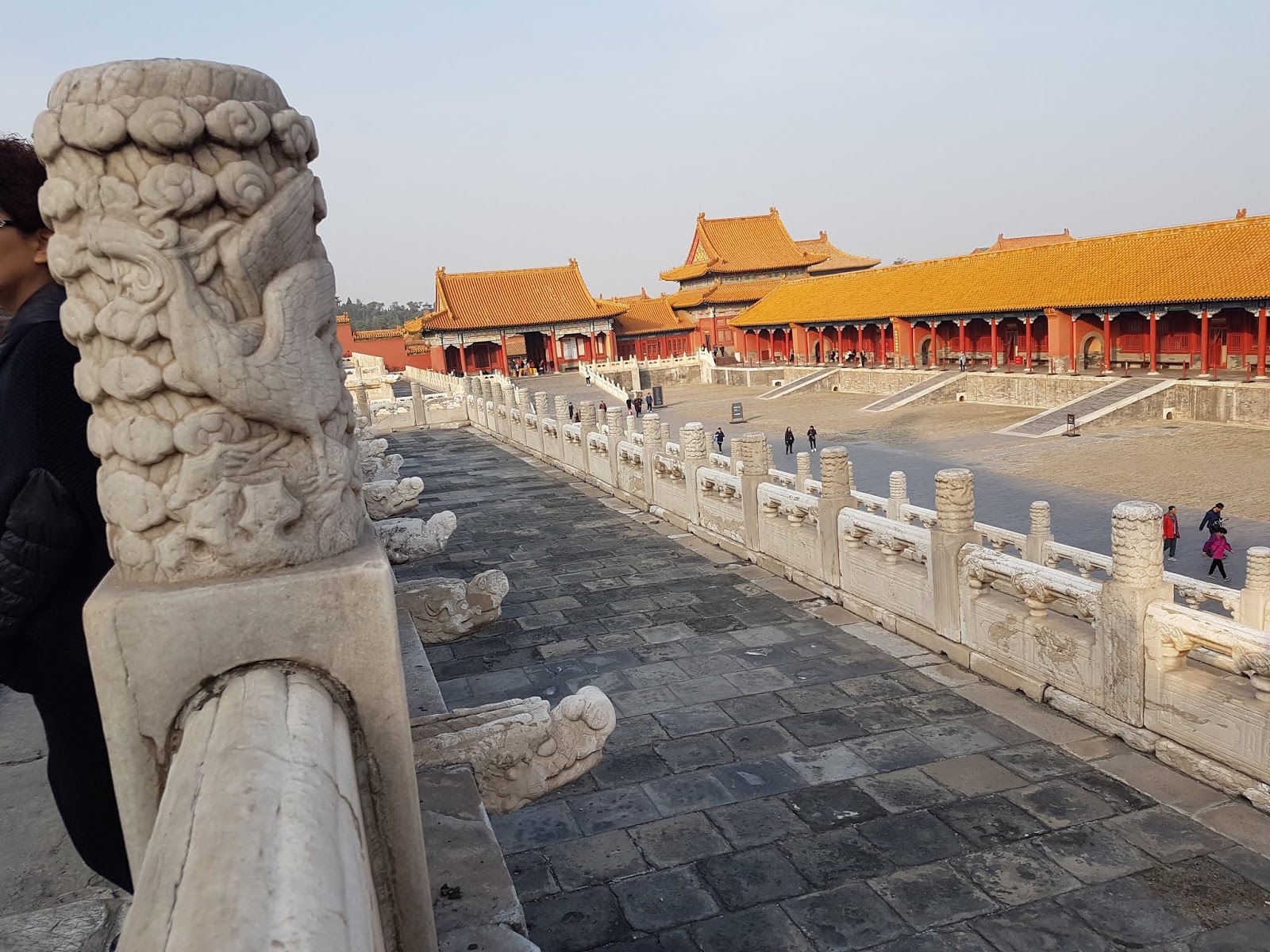
Earlier I referred to the sumptuously carved balustrade. You can see this in a little more detail in the picture below. Every element of the vast balustrade is hand carved and unique. The variations on the themes of dragons and monsters stretches the imagination of the most enthusiastic of Dungeons and Dragons gamesters. Not only that but the whole system also forms an elaborate drainage system partly resembling the gargoyles on medieval European churches. 


Here we are looking down towards the Palace of Heavenly Purity and the start of the domestic part of the complex.  The gate and wall form the division. If you look carefully you will see four large gilt bowls, one either side of the far steps and close to the start of the undecorated part of the pink wall. They are about 3 metres in diameter, weigh 4 tonnes and hold 4 tonnes of water. They are designed as fire extinguishers. In winter charcoal fires would be lit under them when there was a risk of freezing. These little reservoirs are all over the City. There is a total of 308 of them. 


The big stone carving which is on the north side of the Hall of Preserving Harmony and can also be seen on the downside of the ramp in the picture above. The single stone weighs over 250 tonnes, is 16.5 metres long, 3 metres wide and 1.7 metres thick. It is the largest single stone carving in China. The marble originally came from Fanghan some 70 kilometres from Beijing. 
There has been much speculation over the years how the stone was transported. The current theory involves a winter road of ice created from water pumped from wells dug beside the road. It was carved in the Ming Dynasty and lies on the Imperial way. Touching it was punishable by death. It portrays dragons playing with pearls above the sea, represented by the waves in the foreground. This kind of bas relief carving was very popular and very fine it is too. 


We then made our way East to look at some of the side palaces and the museum shops, which were closing. We left through the East gate having spent nearly four hours in the City. I reckon we saw less than half of the place. It's definitely a meal that requires more than two sittings. Talking of meals we stopped off at a local cafe for a meat and noodle dish for peanuts as it were. Then it's back to the hotel because we have an early start tomorrow morning in preparation for the GREAT WALL WALK. 

Wednesday, 13 November 2019

Japanese Jaunt with a rugby ball. 3rd Nov Finally the last post.

Nearly over now, the rugby is done and dusted, definitely double disappointment. There was always the danger that a tired and depleted Wales would be caught on the bounce by the All Blacks with wounded pride. England however, right from the offset couldn't manage to create the power and dominance they achieved last week. The handling errors were back and every South African scrum turned into a penalty. Fears that England had played their final in the semi seemed to be true. Here's the pub not far from Tokyo station that we watched both semifinals and the finals.


On each occasion we managed to get seats, either by reserving them or by a little gentle pleading. If you hadn't reserved seats the options were either the pavement or a small cordoned off standing area. Once seated you had push button waiter service for food and drinks. The view looking the other way.


Both of these pictures were taken before the game started and don't convey anything of the atmosphere created once the game under way. That's enough about rugby, let me tell you of some of the other things we did.
You might have heard of the Tokyo Sky tree. It became the world's tallest structure in 2010 and reached its full height of 634ms in 2011. The Burj Khalifa has since knocked it into second place. Visitors can get as far as 455ms and here are the views. I can remember reading in Scouting for Boys that the height of a tree could be measured by using a combination of your stave, the tree shadow and the time of day. Using this method I can confidently tell you that the Skytree is 3 miles high.


This is the view towards Mt Fuji which is over 100kms away and almost always concealed by the smog.


Vertiginous views from the glass floor down to the ground.


Up the lift shaft, quite fast at 600ms per minute or 36 kph.


Finally a couple more views, by day, 


and by night with its head in the clouds. 


A river cruise is one of the things to do in Tokyo, so we decided to enjoy one and here are a few views from the river. Our boat was quite conventional but let me introduce the bulletboat.


Not quite La Grande Arche Paris but interesting proportions nonetheless and perhaps paying a little homage to that eighty year old style of Art Deco. 


Tokyo's original TV tower. It is a lattice steel structure modelled on the Eiffel Tower. Finished  in 1958 the tower is 333 metres tall which makes it Japan's second highest structure. By 2011 it was found to be too low to deliver Japan's Digital Television service, mainly because of the size of the buildings around it. This gave rise, as it were, to the Skytree. 


Tokyo's relationship with water is quite Venetian in its nature. This can best be appreciated by riding the monorail from Haneda Airport towards the city centre. 


After the boat trip we explored the shopping alleys around Asakusa station. This lively area awash with shoppers, tourists, worshipers and people just having a great time. And then along came the parade. I really don't know what this parade was all about but I can tell you that it was noisy, all singing and dancing, but also very well organized. There were stewards to create the space, pole pushers to lift the high tension cables (they are the red and white barber's poles either side of the parade) as well as the musicians, dancers and effigy carriers. Great fun was being had by all. 


Just a little further on and we encountered Senso-ji. This is Tokyo's oldest and most significant Buddhist Temple. First built in CE 645 and rebuilt many times but the last time after WW2 when it was flattened by American fire bombs. With 30 million visitors per year it is the most visited spiritual site in the world. The picture you see is the Thunder Gate within the Temple enclosure and leading  up to it is what I called fortune cookie lane. The shops and stalls all around have been supplying pilgrims for 1500 years with nourishment, clothing and trinkets. For information about the future it's the street below. For a donation of 100 yen (75 pence) you can push a number out of a tin. The numbers refer to one of one hundred drawers, each of which contains a different fortune, either good or bad. It's the True Cross all over again, attract the crowds with some impressive  mumbo jumbo and fleece them. 
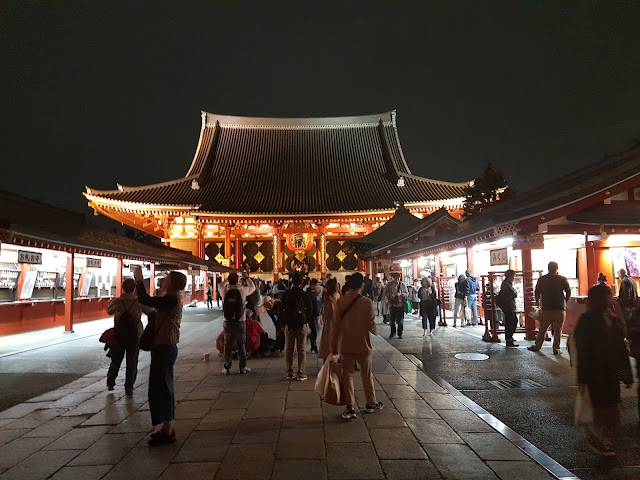

This five tier pagoda is part of the complex. This picture also allows you to get a closer look at the Thunder Gate. The huge red and black Chinese lantern is in the  central alcove and represents thunder and lightning along with the gods standing in either end alcove. Raijin is the name of the 12 foot tall god in the  end alcove. Interestingly he is the Shinto god of Thunder. 


This is a photograph of the front page of one of Japan's popular newspapers on the  morning after the World Cup Final. When I say front page you must remember that tategaki Japanese is written in vertical columns which are read from top to bottom and from right to left so this looks like the back page to us. 


Now I suppose that it is fitting that in what I am calling the last post I should try to sum up our reactions to the country and its people. The first and immediate impression that all visitors have is what a clean and tidy place this country is. In public places this is most striking. You do not see any litter, anywhere. There is no graffiti. Unlike, for example, Singapore where you get the impression that the cleanliness is largely the result of draconian enforcement laws, in Japan it is the will of the people, the culture of the country. 
Public toilets personify this point. In many countries these are the very last places you would want to enter. In Japan, not only are they ubiquitous, they are havens of pristine perfection. Universally equipped with paper, heated seats and a baffling array of sprays and sprinklers to ensure your nether cleanliness. They are emblematic for the state of the nation. 
There appears to be no underclass. I never saw a beggar. Now begging is illegal but also pointless because self reliance is central to the Japanese psyche so asking people to support you runs completely contrary to this concept. Unemployment is currently 2.4% and I saw no evidence of homelessness. However it's estimated that about 15000 are homeless nearly all males over 60 years. They are rather a shadowy group as they personally feel some stigma associated with their status. Japan comes third in the list of countries with the lowest crime rates in the world, (Bahrain and United Arab Emirates beat it, UK's rate is three times greater) so you feel pretty safe on the streets. Just let me break this text up with another picture. It's not relevant to the text, just a nice picture. 


Here's a Christmas tree in Ueno station Tokyo. The station is owned by East Japan Railway which, with its network, transports more than 17 million passengers per day. You will see the name Atre which is a huge chain of department stores all centred on JR East stations. Handy shopping when you are dashing to or from work. But Christmas? Apart from a decorative tree and a C word, can you spot any references to a religious festival? Of course only 2% of Japanese claim to be Christians. The celebration is for a time of happiness and couples may exchange gifts, but like that other heathen country it's hogmanay when they go to town. Incidentally, Himawari means sunflower, but is also the name of a seven year old girl. She is an animated character from the Anime comics that are compulsive reading for many. Marketing is the same the world over. If you haven't got Christmas, you invent it.


There are a lot of old people in Japan. 26% of the population is aged over 65 compared with 18% in the UK so arrangements for care have been carefully planned and implemented. The culture of self reliance that I referred to extends to families supporting each other, especially the respected elderly. In 2000 long term care insurance (LTCI) designed  to cover all those over the age of 65 according to their needs was introduced. As such the system is one of the most comprehensive social care services for the elderly in the world, built around reducing the burden of care for families. 
So I have given you a few facts, figures, impressions and opinions on this fascinating country. The Japanese people that I met were unfailingly friendly and always very helpful. Just stand in the street with one of those street maps that hotel receptionists give you and I guarantee that someone will be by your side within seconds to help you on your way. 
Surprisingly for their culture, cleanliness and Shinto worship of the environment, the Japanese record on environmental issues is not good. It's  the world's fifth biggest carbon emitter and only now is thinking seriously about renewable energy production. The ubiquitous vending machines, so much a part of the urban landscape eat up a huge amount of energy. Plastic bags are generously doled out at every shop. About 30% of men and 10% of women smoke. Smoking is still allowed in pubs and restaurants which comes as a surprise. After the Fukushima nuclear disaster Japan has increased its use of coal for power generation and exports a large proportion of its coal. 
Having made that caveat, would I go back to visit again? The answer is undoubtedly yes, it's a great country with fabulous people.