Sunday, 21 January 2018

An Indulgence in India Thursday 18th Jan2018

The hotel that I booked turned out to be very disappointing. Bits of it look quite nice but the general impression is that of a seedy joint that almost totally lacks creature comforts. There is another reason why l, in  particular,  wish to forget it and that started at about 4am on Thursday morning. It continued at two hourly intervals for the next ten hours. That pretty well put paid to any activities except ablutionary ones for the day. Now this kind of problem is more usually Helen's and it is very unusual for my bowels to let me down, as it were. In many respects this enforced rest did us both a lot of good because we really needed it. Jaipur is quite doable in a day as I will go on to describe, so now we are scrolling on to Friday 19th January.
The city of Jaipur is effectively privately owned by the Maharaja who is an extremely rich 19 year old. He still has a private army that he uses as security at his various Palaces. They are based in the huge hilltop Fort above the Amber Palace which is our first visit of the day. Incidentally it is pronounced amer as the Indians find the b difficult. On the way we pass this iconic site of Jaipur. This is the Hawa Mahal built in 1799 by the Maharaja to allow his many ladies to gaze on the activities of the market place. There are great views to the rear of the Palace and forward to the desert beyond the city if you climb up to the top. I wonder how much the IndusInd Bank pays for product placement in every tourist's photo.


If you are differently abled as it is consistently called in India then you can use your taxi to get to the top, otherwise you either walk or go the Maharaja way on an elephant for Rs 500 a head. It's what is called value-added or just good fun. The trouble is you are a sitting duck for the hawkers trying to sell you Maharaja paraphernalia, textiles, toys etc etc. Jaspal gave us the best advice and that is just to ignore them and avoid eye contact, that way they go away a little sooner. It does work.


The view from the top of the hill at the entrance to the Fort. This is the lake below with one of the gardens for the pleasure of the residents.


This shot gives you a good idea of the scale of the complex along with the fortifications that are in place. If you look carefully at an enlargement you will see the wall stretching all the way round the mountain top horizon. The Amber Fort is behind us and two further forts on the hills 600 metres higher behind that. The wall continues on the same scale for 360°and stretches for 12kms around. It is called the Great Wall of India. You can see some of the old city in the dip.


You arrive and dismount in a huge square with the original stabling for the elephants, camels and horses. We then enter the public audience square and this is the gate from there into the more private part of the Palace. The gate is painted stone, again remarkably preserved and of Hindi design. 


Going through the above gate we reach the most beautiful part of the Palace. The second largest hall of mirrors in the world (the biggest being Versailles) It is breathtakingly beautiful. It's not just the mirrors and inlaid stones that sparkle but the honeycomb effect that I have tried to show in the second picture, that causes the light to bounce off so many surfaces. 


The honeycomb effect I mentioned.


We are not allowed to enter this part because the walls are decorated only with precious stones.


The private garden for the pleasure of the Royal residents


And now on to some details of the creature comforts. I do like to collect stories and pictures of unusual toilets as some of you may know and here is one to add to the collection. The picture below shows two toilets. These are over 400 years old, but are flushed by water coming down a concealed pipe behind the wall and  used to clear the trough.  The left hand trough is designed to be sat on, whereas the right hand one, you stand on the shelf and squat.


This is detail of the roof in the hammam.It is a jacuzzi with hot water fed though pipes which squirt into the bath tank. All luxury treatments were available. The facetted carving and the crystalline nature of the marble reflects light around the room so a single oil lamp would make the whole room glow with light.


Lastly we looked at the sleeping arrangements for the ladies and the peeping arrangements for the Maharaja. We also had some more retail opportunities and managed to sit down for a coffee in the Indian equivalent of Starbucks. Time to head off back to town. On the way we passed the Water Palace which you can see in the picture below. The Maharaja decamped here in the height of the summer to try to escape the heat. This is a three storey building but the bottom floor is under the water.


After a pleasant lunch we had the opportunity to see how the fabrics are block printed with up to seven different colours being used. This is a local speciality and we end up making a couple of purchases.


Our next stop is the Jantar Mantar, an observatory with a difference. Here you will find no lenses or telescopes, instead what appears to be bizarre modern sculptures. Its name comes from the sanscrit and means instrument of calculation and this best describes its function. It was built by Jai Singh ll in 1728. He liked astronomy even more than he liked war and town planning. Astrology is central to Hindu beliefs and has a bearing on every decision that is made especially things like the choice of a husband or wife for your offspring. There are twelve instruments each aligned to its own astrological sign. Here is me with my star sign of virgo.


This is the largest sundial in the world. It is accurate to within 2 seconds. Let me explain how it works. The very large wall on the left is the gnomon. The edge of the shadow is where the time is read on the arc of the quadrant. This side is where the time is read in the afternoon. In the mornings time is read from the arc on the quadrant to the left of the gnomon.


The instrument below measures the azimuth of a heavenly body. You have to attach a wire to the centre (gnomon) of the drum thingy in the middle and with a weight, dangle it over the outer circle. Bob's your uncle
  

In case you are wondering what the devil azimuth means, I will give you the definition. The direction of a celestial object from the observer, expressed as the angular distance from the north or south point of the horizon to the point at which a circle passing through the object intersects the horizon. OK? 

Saturday, 20 January 2018

An Indulgence in India Wed 17th Jan 2018

Today we are driving from Agra to Jaipur. Jaspal does not much like Agra because the people are too aggressive, l suspect it is because the majority of the people are Muslim. However our experiences today are going to support his opinion. The plan is to drive to Fatehpur Sikri and look round this Mogul ghost city, then drive on to the Keoladeo National Park and spend some time communing with nature.

You must park a little distance from Fatehpur Sikri and then take a short bus ride up to the site itself. The city was built by the Mogul emperor Akbar who had consulted a local Sufi prophet who predicted a male heir to the emperor. When this came true he decided to build a new capital here in 1572 only to be abandoned in 1585 due it is thought to a shortage of water.

There were three Palaces, one for each of his wives, one Hindu, one Muslim and one Christian (although the local Hindus  dispute these claims). He also built a  huge mosque which is still in use today. Visiting the mosque complex is free but the rest requires a guide and large entry fee. We opt for the free ticket and enter the doors below.


Inside the mosque complex with its indo-mughal styling. This is the Tomb of the of the prophet's grandson which is next to his grandad Shaikh Salim Chishti.


This is the  Grandad's Tomb. Remember, jhe was the one who got lucky with the birth prediction. Now women hoping to have children tie a thread to the carved filigree marble screens. It was finished in 1581.
"

This is the east side of the mosque. This imposing gate only really gives access to a north-south corridor, much like a cloister. The painting and decoration is in remarkable condition considering its 500+ age tag.


Here we are looking down that cloister. Once again look at the intricacy, detail and quality of the workmanship. 


Finally for you apiarists here is a lovely swarm of honey bees that is about the size of a football. It was described by a local as a nest.


I have good memories of my last visit here in 1997. I cannot say the same of 2018. Our trip was totally spoilt by the invasive persistence of masses of hawkers, would be guides (illegal and unqualified), and brazen barefaced beggars. Touts and hawkers are a problem throughout India but never have I encountered it as unpleasant as it is at Fatehpur Sikri. So, thankfully goodbye to that and I won't come back until someone does something about it. I would recommend any tourist thinking of coming here, to think again.

Quite close to Fatehpur Sikri and on the way to Jaipur is the Keoladeo National Park. Historically this was a huge hunting ground for the Maharajas but as their leisure time pursuits evolved it became a nature reserve. The park has also been declared a World Heritage Site. It is particularly important for the bird life both migrant and residents as it has extensive wetlands as well as shady arid jungle areas. The reptilian species are also most abundant.

On entry there is a large notice specifying all the prices. There is an entrance charge, Rs 500 each, rickshaw hire Rs 150 for the two of us and the use of a guide Rs 250. So that's Rs 1000 plus Rs 400, Ok? So off we were pedalled and we soon encountered birds. These were the first that the guide pointed out. LBJs I thought but apparently they are called Silver Bills. It's a pity that you can't see their bills.


Pigeon you scoff, but no, it is a Laughing Dove and really quite attractively coloured.


Quite small chappie this, as the name suggests, Spotted Owlet


I spotted this solo observer on high, much to the delight of the guide. It is a vulture. In the 1980s there were 40 million of them in India. Since the introduction of diclofenac the number has decreased to around a mere 100000 which is a 99% decline.


A loving couple whose amorous behaviour would not be approved in Pushkar. They are Green Parakeets who have modestly got themselves out of focus.


Shikra, a hunting bird that was used in falconry.


Red-Vented Bulbul whose diet includes the occasional gecko


Nestling amongst the branches you can spot a yellow footed green pigeon.


The wildlife here was really great and we hadn't even got to the wetlands where there are thousands of migrants. It was time for us to go back as we had only allowed ourselves one hour, not wanting to have to drive back to  Jaipur in the dark. It was time to pay. We had sorted out the Rs 1000 entry. So just the Rs 400 balance. I hand over Rs 500 giving the two guys a Rs 50 tip each. But no. We are wrong. The cost is 2×250Rs plus 2×150Rs. Helen argues the toss, vigorously. We take them back to the price board to show them exactly what it states. The guide offers all the money back. We don't want it back, we just don't want to be cheated. We leave with a very upset Helen and a very disappointed Jaspal  who is ashamed of his countrymen. Oh dear today we have seen some of the worst aspects of India.


Friday, 19 January 2018

An Indulgence in India Tuesday 16th Jan 2018


Today we left Hotel City Star and set off on our route round Rajasthan, the first destination is Agra. We are heading south east towards the satellite city of Noida which is a huge business and commercial centre. The express way we are driving on is part of the infrastructure, as is the metro which is under construction. The area is a mass of very high rise buildings all under construction. Jaspal  tells us that the area is unsafe so people don't live here, however Noida (for those of you who love acronyms stands for North of India Development Area) is a huge thriving city and very rich. With the funds it has in its coffers now (Rs 3500 crore) enough to run the entire city for 5 years without taxing its citizens at all. Sport City is located here along with the F1 racing track. 
The express way is a toll road all the way to Agra. This however does not make for safe or fast driving. There is absolutely no road discipline. All the heavy lorries travel in the outside lane of 2 leaving the hard shoulder and the inside lane available for undertaking, cows bikes, motorbikes etc. So the Delhi weave continues at a higher speed on this would be motorway. Add to this the fact that instead of going round towns, the road goes straight through the middle of then which encourages a frenzy of commercial and industrial activity on the road side. 
We arrived in time for lunch and met our guide for the visit to the Red Fort and Taj Mahal. His name is Shahzad Baig and is, as you would expect very knowledgeable. He is keen to help and takes the appropriate photos of us. He was also keen I should mention him in this blog. So if you are looking for a guide at Agra give the Prince a go. You can contact him at baig.guide@gmail.com He is, of course my uncle and I am on a 10% commission! 

The Agra Fort has to be one of the most protected structures that I have ever seen. One side was protected by the river Yamuna. The entire Fort has 20m high ear shaped walls but before you could even touch these there were 2 moats, the first, a dry one containing hungry tigers. The next moat was water filled but had the added bonus of being filled with crocodiles. The single gate had a drawer bridge as usual and very sturdy doors then a steep ramp with a 90° bend.  There was an arrangement whereby oil could be poured onto the ramp to make it slippery, then set on fire 🔥 if needs be. Phew! 


The Fort was originally built by Akbar in 1565 but its most famous resident was Shah Jahan. He of the Muntaz wife for whom the the little white monument across the river was built. Shah Jahan converted the fort into a magnificent Palace which was to become a gilded prison when his son Aurangzeb seized power in 1658 after murdering his way to the top. 
Here you can see his "retirement house" with the symmetrical mogul garden. Sorry the white marble has resulted in an overexposed shot. This garden seems to me to have parallels with the Elizabethan knot garden 


Here you can see some of the most beautiful internal decoration with precious and semi-precious stones inlaid into the marble. This is a skill that is still in action today as can be seen in the tourist workshops


I show this as it is the only remaining monument to a British official left in the Fort but I have no idea why. He died of illness during the First War of Indian Independence or what my history books would have called the Indian Mutiny.
.

Vehicles are not allowed to approach the Taj Mahal so we have to park and the take a rickshaw for Rs 50 to the ticket office. The entry ticket is Rs 1000 about £12 which, for the most iconic building in the world I thought was very good value. Locals have to pay Rs 50 but with the high value ticket you don't have to queue. Taj Mahal means Crown Palace and I suppose most people know the story of,  but as you are reading this I better tell you again.                                                            
Firstly a couple of descriptions, Rudyard Kipling said it was "the embodiment of all things pure" and rather better the poet Tagore called it "a teardrop on the cheek of eternity". Now that is what I call poetry.
Built by Shah Jahan as a memorial to his wife Muntaz Mahal who died giving birth to her 14th child in 1631. The death of Muntaz left the emperor so heartbroken that his hair is said to have turned grey overnight. Below you can see the south gate through which most tourists arrive. Here we are standing at the centre point of the formal garden. The Taj itself is directly behind us.


The view below is a classic from the south gate and I've nearly eliminated the madding crowd,unless you look closely at the marble plinth that the building stands on.


The false tomb of Muntaz lies in the centre of the building. The false minarets are 40ms high and slope slightly away from the Taj. This is in the event of earthquakes, they will fall away from the building. Shades of Surfleet church! Out of the shot are mirror image buildings. Only the one to the left is a mosque as the other one faces in the wrong direction. The white marble was quarried in Rajasthan and is inlaid with precious and semi-precious stones, a technique called pietra dura. This is still a specialist skill of local artisans. The Taj itself took 8 years to build but the entire complex took 22 years.


This really is the classic picture, taken from the centre of the garden, like the first, only facing the other way round. This is where the Princess Diana bench is. She still seems to manage her publicity from beyond the grave.


A last shot of the south gate giving a better idea of the numbers of visitors attending. You come to this building with great expectations and you leave like Oliver Twist asking for more. 

Thursday, 18 January 2018

An Indulgence in India Monday 15th Jan 2018

Monday is not the best day for sightseeing in Delhi because so many things are closed. However Sikh Temples are open and welcoming to all comers. Jaspal was keen to show us around and explain the nature of the Sikh religion.


This is the Gurdwara Bangla Sahib Sikh0 Temple. It is a magnificent white marble edifice topped with golden onion domes. It is a wonderful haven of peace with live music wafting through the atmosphere along with readings from the holy book. There is a dress code as you can see, bare feet and covered head. Nobody asks for money. There is a residence where you can stay at no cost and a very large hall that distributes free food. This is prepared by volunteers, so we did our bit. Helen preparing the chapatis. 


Sikhism is unusual for several admirable reasons. It makes no attempt to convert people, stresses the importance of tolerance and personal respect between peoples. They are not cheek turners however and have formidable reputation as warriors. The temple was built to commemorate the 8th Guru Harkrishan Devon who tended to victims of cholera and smallpox as a 6 year old before he died in 1664. There is also a large tank of water which has healing properties. 


Bit like Lourdes really same idea different God. We moved on to another water feature, this one being considerably earlier at C12 CE. It is a step well which allows people access to the water no matter how the level changes. 


As our car is going in for a service prior to the long trip, we have the use of Rajan's brand new big smart car and driver who is called Ram. Maybe this is a bit of a sales pitch as we are offered the use of this car for all the trip at a higher price.  There is another thing that is restricting our activities and that  is the state visit of the Prime Minister of Israel 🇮🇱 Benjamin Netanyahu. He has obviously read this blog because he is planning to visit the Taj Mahal tomorrow at the same time as us. Maybe he can move to a morning slot. 
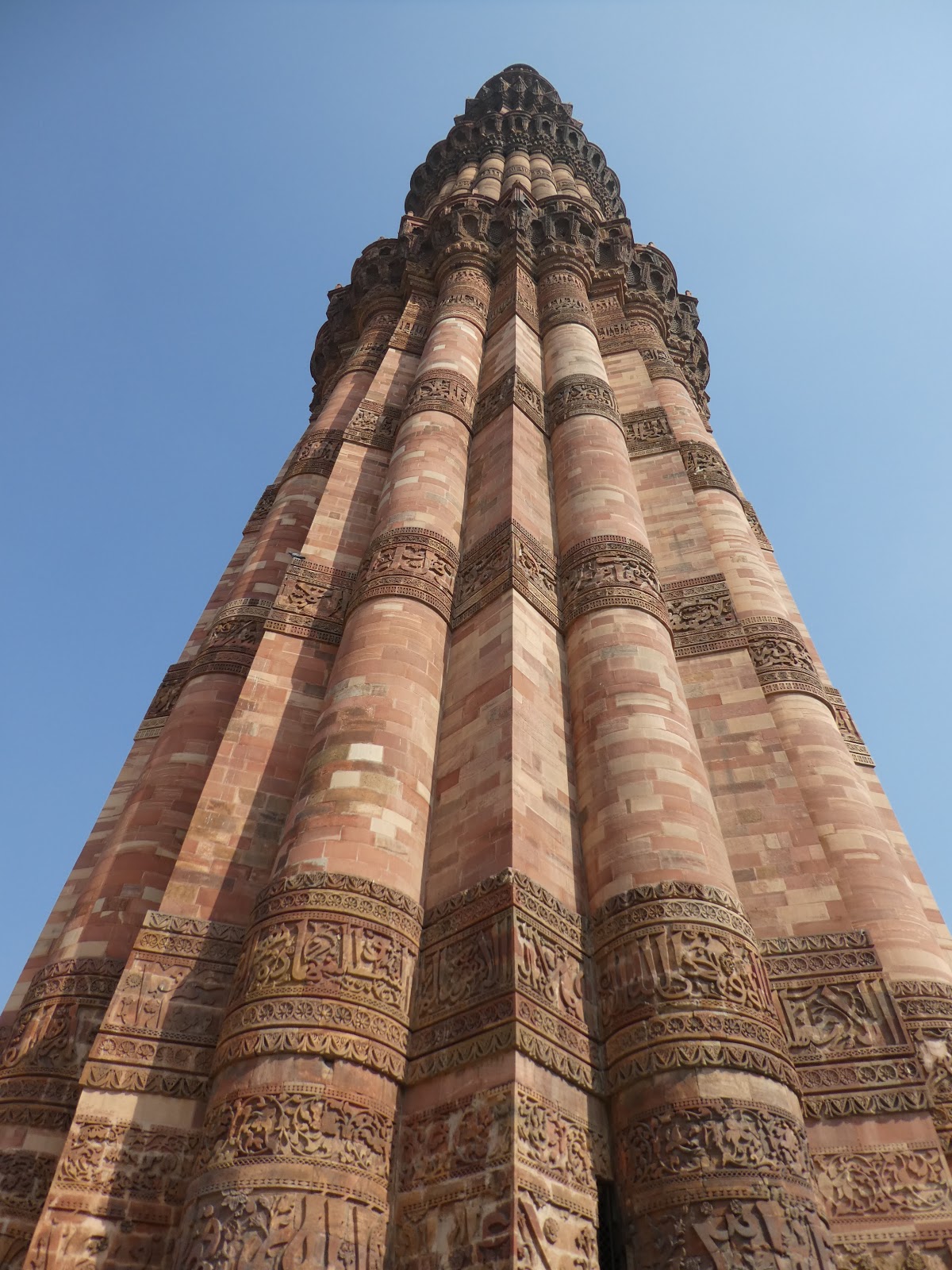
Next trip, to the Qutub Minar complex is a site of ancient ruins which is rated as Delhi's top attraction to visit. The vast majority of the visitors are Indian, then Japanese and finally westerners. It was started by the Sultans of Mehrauli in the late C12 Century. The Afghanistan style victory tower pictured below is the earliest and most prominent edifice of the complex. Other surrounding structures are mosques, including the earliest built in India, tombs, another ruined base of a tower which would have been even larger than the first and the iron pillar. This is worth a word or two. It is about 7ms tall and inscribed to commemorate the victories of Chandragupta ll who ruled from CE 375 to 413 making it twice as old as anything else here. Scientists are unable to explain how it was cast with the technology available. Nor does it rust, the combination of its purity and the dry atmosphere. Wow! Nearly as amazing was Helen's popularity as a member of people's selfies. She was politely asked and then always very gratefully thanked. They couldn't get enough of her. 


We then drove out with Ram to Humayun's Tomb. Similarities with the Taj Mahal are no coincidence, as it seems to float exquisitely above its surrounding symmetrical gardens, it was the inspiration for the Taj. It has been recently cleaned and restored and with its restrained decoration and strict adherence to the rules of Islamic geometry looks really splendid. 
Helen continues to be in demand for selfies. I wonder if I look like Prince Charles and it is a case of misindentification? 


Our last visit was just a photo shot really of the Lotus Temple. A very striking modern building that was unfortunately closed to visitors on a Tuesday. Oft compared with the Sydney Opera House it was designed by the Iranian - Canadian architect Fariburz Shahba in 1987 for the Bahi faith. Bahi is a sort of esperanto of religions optimistically hoping that all people will get together under a common god for the common good of mankind. It's founder was called Baha'u'llah, born in 1817  and, disappointingly came from the middle east, again. More disappointing as a man he failed to break the mould by being a woman. Such is life, nothing really changes and I now really have to go to bed. 


Tuesday, 16 January 2018

An Indulgence in India Sunday 14th Jan 2018

I am writing this on Monday 15th because the WiFi went AWOL yesterday, leaving me somewhat pushed for time. So I'll skip along then. We arrived at Heathrow with plenty of time in hand. Terminal 2 is quite smart now and security checks are brisk and efficient. We spent a bit more cash on direct flights giving us a flight time of just under 9 hours.

Now I always thought that the world was divided into one hour time zones but I am clearly wrong as Delhi is five and a half hours ahead of the UK. I wonder if the zones get any smaller allowing people like me a really good excuse for being late. I digress however.  We boarded and settled down for the cabin crew safety demonstration. They started, and it was like a silent movie without the pianist. You start to think if that bit is bust, then what else? After a short delay, the book came out and we were given a reading in Urdu, I think and English, I think. Next it was up and away. I decided to watch a film and can recommend Dunkirk as an aural experience as well as a visual one. After landing, visa, passport and luggage, my worst fears evaporated when we were actually met and welcomed by Rajan who introduced us to Jaspal Singh our driver.


Jaspal as you can see is a member of the Sikh faith and also a very smart driver. Driving in Delhi is can be a life changing experience, a little like the film Dunkirk,  things are coming noisily at you from all directions. The larger roads have three lanes marked, down which travel four and a half lanes of traffic. They attempt to squeeze in a constantly weaving pattern of rickshaws. tuc-tucs, cycles, lorries. buses, motor bikes ox-carts and cars. Loudest horn has priority. Note the marigold garlands that Jaspal has given us. I think these are in place of airbags. I jest, of course. The maelstrom of traffic doesn't turn a hair on Jaspal's head.
We were dropped off at the hotel which fronts on to a very busy and noisy road. We get a large room in the rear with a bed that is so wide that Helen and I set a half hour time difference between her side and mine.


The following morning we met up with Jaspal again for the first of our two days in Delhi. We have a guide laid on called Mada Singh (my apologies if I am spelling this wrong). You can see him and Helen in the next picture where we are on our first visit of the day. This was to the Jama Masjid, a huge mosque built by the Mogul ruler Shah Jahan between 1644-1658. It is a haven of calm at the heart of Old Delhi. The square can accommodate 25000 worshippers. The towers were 40ms tall.


 You might wonder what Helen is up to, but a certain dignity and decorum is required to be displayed by visitors.


The old spice market is very close to the mosque and was our next destination. The whole area is a maze of narrow lanes with small independent traders plying their wares which range from wedding paraphernalia to pots and pans. There were also a group of men squatting with buckets filled with paint brushes or pipes and taps or saws and chisels who were really selling their trade skills. In the middle of all this is the spice market. There is only one way to travel around this highly congested area as you can see. Here we are on our way to the market. If you are wondering what is between my legs you might be relieved to know that it is only my reversed bum-bag.


The spice market has now become a world wholesale centre. Spices arrive from all over the globe and are re-exported wherever there is the demand, a little like flowers are in Holland. They are also sold locally, of course.


The labour here is hired on a daily basis. Men are attracted in from the surrounding countryside both far and wide and camp on the roof tops. They support their wives and children by sending them spare cash. Earnings are unpredictable and sporadic. If they can earn £50 per month, which is about average it keeps a family's head above water. You can see their living conditions for yourself. Cleanliness is a priority.


All the washing, carpets and mattresses you can see  belong to these guys. The once rather elegant old buildings you can see were originally built by the British. Of course I couldn't resist a spicy purchase or four. When we were on the rickshaw we squeezed past a group of men chanting and walking in crocodile whilst carrying a stretcher at shoulder height. Lying on the stretcher was a thinly shrouded corpse. Everything seems to happen on these streets.
What isn't happening is much tourist activity around the India Gate and Parliament Street, nor at the Red Fort. This is a security measure for the upcoming Republic Day when Indians celebrate what we would call Independence Day and they more correctly refer to as Freedom Day. Next we headed for a park devoted to Mahatma Gandhi just across from where his body was cremated. This was about as close as we got to the Red Fort, closed for the above reasons.


There is always the freedom of the air, and I include this photograph especially for you, Richard Berry. With your birding experience I know that you will recognise these oft mentioned avians.


For those of you that lack Richard's knowledge, they are those cleaners of the streets we call kites.
If you are a believer in the Hindu religion your avatar may well be one of those birds but you will certainly be interested in the next visit. This was to Lakshmi Narayan temple sponsored by BD Birla a wealthy industrialist. It honours Lakshmi, the goddess of wealth. Gandhi inaugurated the complex in 1939 as a temple for all castes. Those of you who know me know how I feel about all religions and my faith that all gods are the worst inventions of mankind. With due respect for its followers Hinduism is a little like the fairground religion. It has a plethora of fantastic gods and goddesses, oft multi-limbed concoctions that mix up different creature and human parts riding on equally unlikely forms of transport. The abundance of tinsel and bright colours all add to the sweety culture of the fairground. I am sure there is a link across Europe with Romany and canal art. I do hope that I don't end up being the first atheist martyr.